

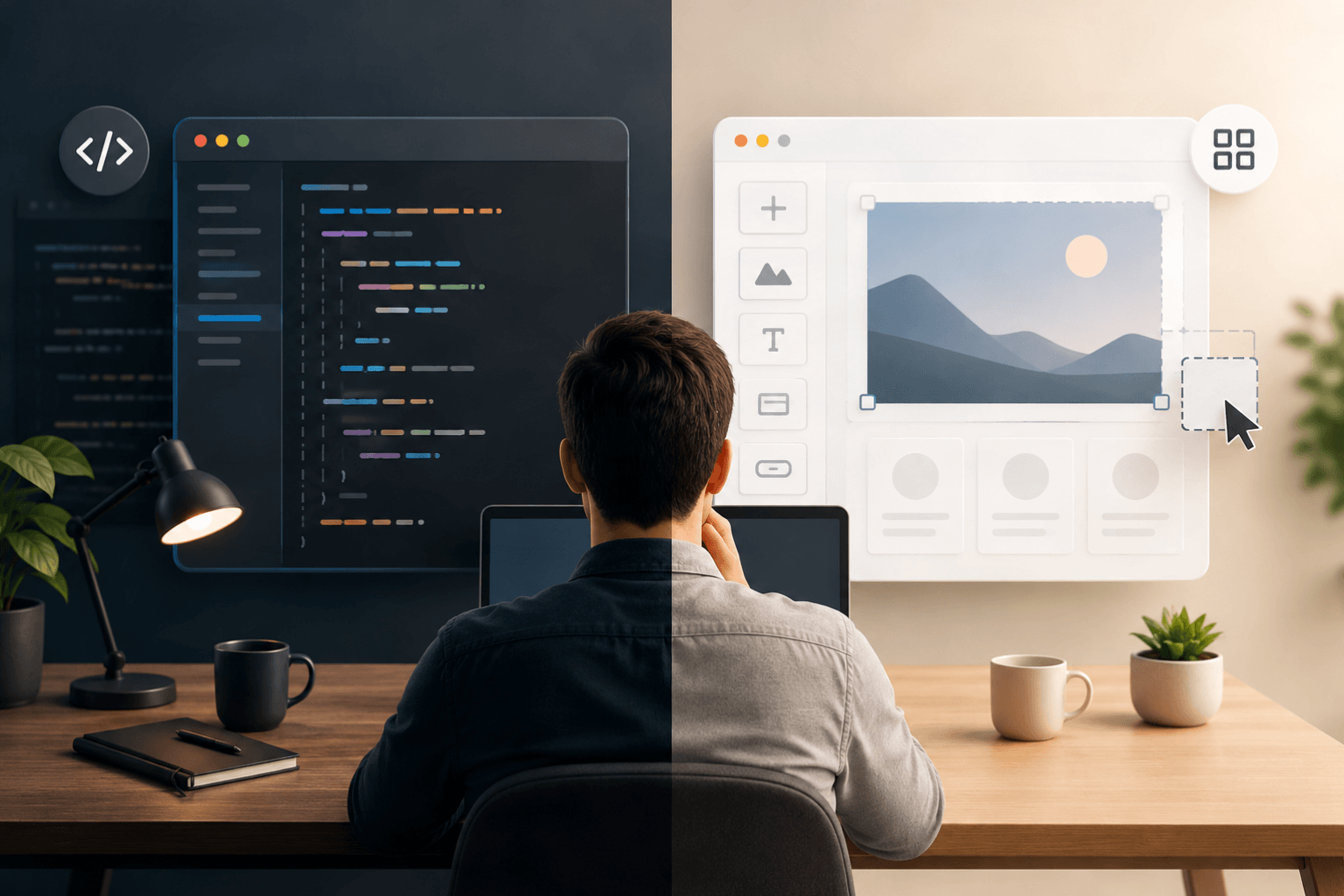
Should you build your website yourself using a platform like Wix, Squarespace, or Webflow — or hire a professional web designer to build it for you? It is one of the most common decisions business owners face, and the right answer depends entirely on where your business is and where you want it to go.
Website builders have come a long way. The platforms available in 2026 are genuinely capable tools that have empowered millions of people to create functional, attractive websites without writing a line of code. At the same time, professional web design has never been more accessible or more impactful for businesses that are serious about growth.
This is not a case where one option is objectively better than the other. It is a case where understanding the real differences — not just the surface-level ones — helps you make the right call for your specific situation. At AG Art Studio, we work with businesses across both paths, and we have seen both succeed and fail. Here is an honest breakdown of the decision.
What website builders actually offer
Website builders are drag-and-drop platforms that let you create a website by selecting a template and customizing it with your own content — without needing to know HTML, CSS, or any development language. The leading platforms in 2026 include Wix, Squarespace, Webflow, Shopify (for e-commerce), and WordPress.com (distinct from the self-hosted WordPress.org).
Each has a different strength. Squarespace is known for elegant, design-led templates and an intuitive editing experience. Wix offers maximum flexibility in its drag-and-drop editor and an enormous template library. Webflow sits at the more advanced end — it generates clean code and gives designers far more control, but has a steeper learning curve. Shopify is purpose-built for selling products online and remains the leading e-commerce platform for most retail businesses.
What all of these platforms share is a hosted, subscription-based model: you pay a monthly fee, the platform handles hosting and security, and your website lives within their ecosystem. This simplicity is their core value proposition — and for many businesses, it is entirely sufficient.
Pros and cons at a glance
Understanding where website builders genuinely excel — and where they fall short — is the starting point for making an informed decision.
Advantages
- Low upfront cost — most plans start under $20/month
- No technical knowledge required to get started
- Hosting, security, and updates are handled automatically
- Large template libraries with modern, mobile-responsive designs
- Fast to launch — a basic site can be live within a day or two
- Easy to update content yourself without developer help
- Built-in tools for e-commerce, blogging, booking, and more
Limitations
- Templates are shared by thousands of other businesses
- Customization has a ceiling — some things simply cannot be built
- You do not fully own the platform your site runs on
- SEO performance can lag behind custom-built sites
- Page speed is often harder to optimize within builder constraints
- Monthly costs compound significantly over years
- Migrating away from the platform later can be complex and costly
What a professional web designer actually offers
Hiring a professional web designer — whether a freelancer, a specialist studio, or a full-service agency — means having someone build your website for you, typically on a platform like WordPress (self-hosted), Webflow, or a custom-coded stack. The scope of what is included varies enormously, but at its core, professional web design means someone else is making the strategic, creative, and technical decisions — and accountable for the result.
A good web designer brings more than technical execution. They bring a design perspective, an understanding of UX principles, knowledge of how design decisions affect SEO and performance, and experience building sites that convert visitors into customers. They ask questions about your business goals before they open a design tool. The output is a website shaped by expertise, not by what happens to be available in a template library.
Pros and cons at a glance
Professional design is not the right choice for every business at every stage — but when the conditions are right, it delivers returns that a builder simply cannot match.
Advantages
- Entirely custom — your website looks and works like no other
- Built around your specific business goals and user journeys
- Superior performance, SEO foundation, and Core Web Vitals scores
- No platform limitations — anything can be built
- You own your site outright — no ongoing platform dependency
- Strategic input from someone who has built high-performing sites before
- Long-term asset that grows with your business
Limitations
- Higher upfront investment — typically $3,000 at minimum for quality work
- Longer timeline — a custom site takes weeks, not days
- Quality varies significantly between providers
- Requires more involvement from you during the process
- Content updates may require developer help if not set up properly
The real question: what stage is your business at?
The most useful framework for this decision is not "which is better" but "which is right for where I am now and where I am going." Business stage is the most reliable predictor of which path delivers better value.
Early stage or pre-revenue
If you are just starting out, testing a business idea, or operating on a very tight budget, a website builder is often the right call. The goal at this stage is to establish a basic online presence quickly and cheaply, validate your offer, and start generating your first customers. Investing $10,000+ in a custom website before you have proven product-market fit is rarely the optimal use of capital.
Established but not growing as expected
If your business is generating revenue but your website is not converting visitors or ranking well in search, this is often the inflection point where professional design starts to pay for itself. A well-built custom website can measurably improve conversion rates, SEO rankings, and brand perception — and the return on that investment compounds over time as traffic grows.
Growing and competing in a crowded market
If your competitors have polished, well-performing websites and yours was built on a template three years ago, the gap is costing you customers. At this stage, the question is not whether to invest in professional design — it is how quickly. A distinctive, high-performance website becomes a competitive advantage that is difficult for competitors to replicate quickly.
Scaling with complex needs
If your website needs to integrate with CRMs, automate workflows, handle large product catalogues, support multiple user roles, or serve customers in multiple languages, the limitations of website builders will almost certainly become a constraint. Custom development is not optional at this level — it is the only path that supports the complexity your business requires.
Scenarios where a website builder is the right choice
- You are launching a new business and need a professional online presence within a week and a minimal budget
- You want full control over your own content and updates without ever calling a developer
- Your website's primary purpose is informational — a digital brochure for a local service business
- You are running a straightforward e-commerce operation with a limited product range and Shopify covers your needs
- You have design sensibility and enjoy working with visual tools — Webflow in particular can produce excellent results in skilled hands
Scenarios where a professional web designer is the right choice
- Your website is a primary revenue channel and underperformance has a direct cost to the business
- You are in a competitive industry where brand differentiation and visual quality are purchasing signals
- You need custom functionality that builder platforms cannot accommodate
- You want a website that reflects a premium brand positioning and justifies premium pricing
- Your current site is holding back your SEO — slow load times, poor mobile performance, or technical issues that builder constraints prevent you from resolving
- You have outgrown your current platform and need to migrate to something more capable
Can you start with a builder and move to custom later?
Yes — and many successful businesses follow exactly this path. A Squarespace or Wix site is a perfectly sensible starting point for a business that is finding its feet. The important thing is to make the transition before the limitations of the builder become a constraint on growth, rather than after.
The signals that it is time to make the move are fairly consistent: your site is slow and you cannot fix it within the builder's constraints; you are losing leads to competitors with more polished sites; you need functionality the platform cannot provide; or you want a visual identity that is genuinely distinctive rather than template-derived.
When you do make the transition, the investment in a professionally built site tends to pay back relatively quickly for businesses that are already generating meaningful traffic — because the improvements in conversion rate, SEO performance, and brand perception compound across every visitor the site receives from launch day onwards.
Questions to help you decide- Is your website currently generating leads or sales at the rate your business needs?
- How does your website compare visually and functionally to your top three competitors?
- Do you have the time and interest to build and maintain a website yourself?
- Does your website need custom functionality that a builder platform cannot support?
- Are you investing in SEO or paid traffic — and if so, is your website converting that traffic effectively?
- What is the cost to your business of a website that underperforms for another twelve months?