

How long does it take to build a professional website? The honest answer is anywhere from two days to six months — and understanding why that range is so wide is the key to setting realistic expectations and planning your project properly.
Timeline is one of the most consistently underestimated aspects of web design projects. Businesses plan a launch around an optimistic guess, content takes longer than expected, feedback rounds multiply, and suddenly a six-week project is running into its third month. On the other side, rushing a project to meet an arbitrary deadline is one of the fastest ways to end up with a website that underperforms.
At AG Art Studio, timeline management is central to how we run every project. Here is a realistic breakdown of how long different types of websites take to build, what drives timelines in each direction, and what you can do to keep your project on track.
Why website timelines vary so much
The range from days to months is not random — it maps directly onto the complexity and scope of the project, who is building it, how decisions are made, and how quickly content is ready. Each of these variables has a significant impact on how long the project takes from kickoff to launch.
Scope and number of pages
A five-page brochure site has a fundamentally different build scope than a forty-page website with a blog, a portfolio, multiple service categories, a team directory, and a contact system. Every page requires design decisions, content, development, and testing. The more pages and unique page types a site has, the longer it takes — and the longer it takes to get right.
Custom design vs. template
A template-based site skips most of the design phase — the visual framework already exists and the designer's job is primarily customization. A fully custom design starts from scratch: brand exploration, mood boards, wireframes, multiple design directions, revisions, and a finalized design system before development begins. This creative process takes time to do well, and that time is what separates a genuinely distinctive website from one that looks like thousands of others.
Custom functionality and integrations
Standard informational websites are relatively straightforward to build. The moment you add custom functionality — booking systems, payment processing, membership areas, CRM integrations, custom filtering, multi-language support, or API connections — development time increases significantly. Each integration requires development, configuration, and thorough testing across devices and scenarios.
Content readiness
This is the single most underestimated timeline factor in web design. Professional copy, photography, video, and other content take time to produce — often more time than the design and development combined. A project that begins without finalized content will stall at the point where content is needed. Placeholder text and stock images are useful for development, but no website should launch without its real content in place.
Feedback and decision-making speed
Web design projects involve multiple rounds of review and approval at the design stage, the development stage, and before launch. How quickly stakeholders review work, provide feedback, and make decisions has a direct impact on the timeline. Projects with a single decision-maker who responds promptly move significantly faster than those involving multiple stakeholders with conflicting opinions or slow response times.
Realistic timelines by project type
With those factors in mind, here is what realistic timelines look like for different categories of website project in 2026.
These ranges assume a professional studio, a well-defined brief, and reasonably responsive client feedback. Add two to four weeks to any estimate if content will be created during the project rather than before it, and if there are multiple internal stakeholders involved in approvals.
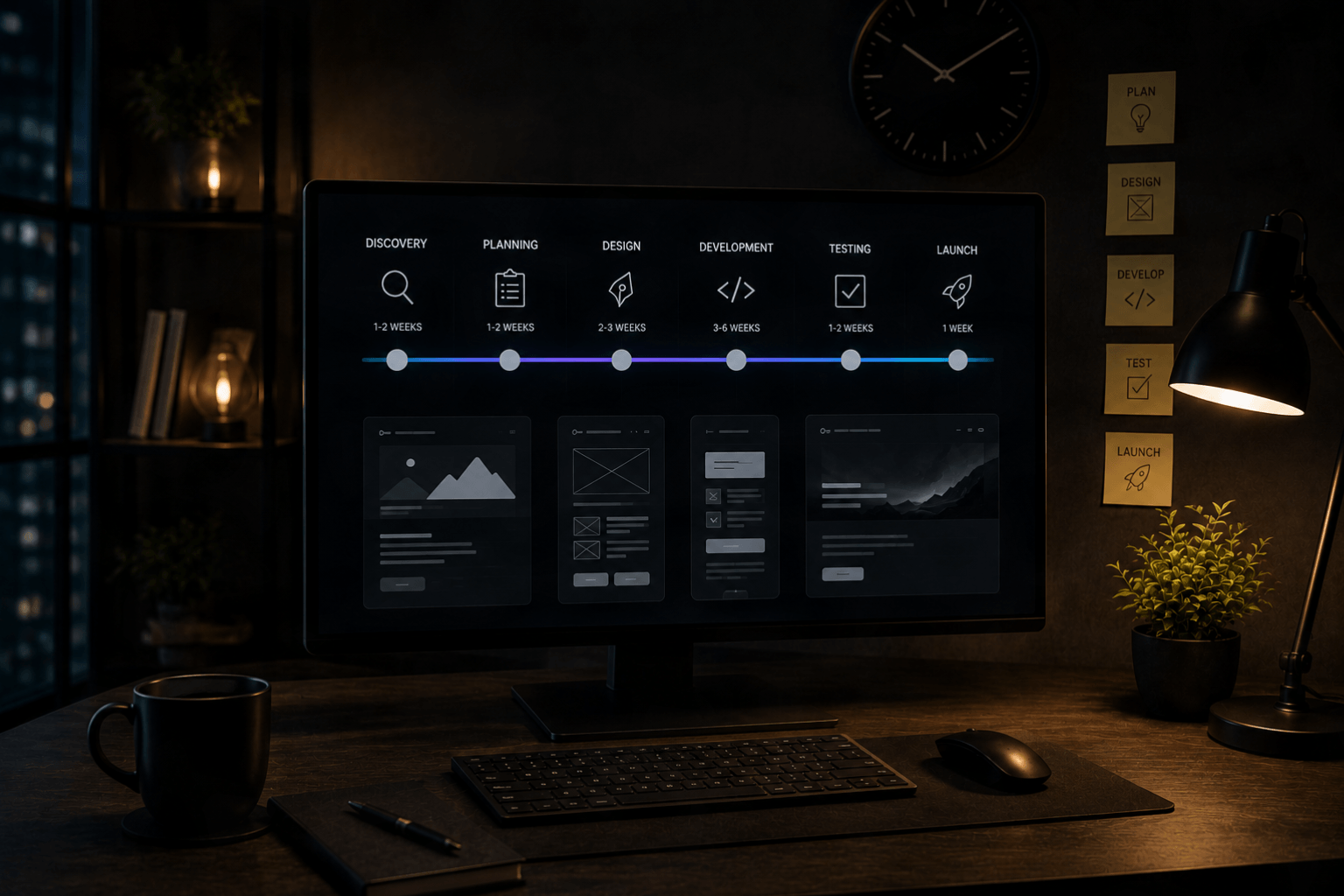
A typical custom website project phase by phase
For the most common project type a custom business website here is what the timeline looks like broken down by phase.
Discovery and strategy (1–2 weeks)The project begins with a detailed discovery process: understanding your business, your audience, your competitors, and your goals. This phase produces a project brief, a sitemap, and agreement on the scope of work. Skipping or rushing discovery is one of the most reliable ways to produce a website that looks right but does not perform, because the strategic foundation was never established.
Wireframing and UX planning (1–2 weeks)Before any visual design begins, the structure and user flow of the website is mapped out in wireframes, low-fidelity representations of each page that establish hierarchy, navigation, and content placement. Wireframes are faster and cheaper to revise than finished designs, and reviewing them early catches structural problems before they become expensive to fix.
Visual design (2–3 weeks)The approved wireframes are developed into full visual designs — with brand colors, typography, imagery, and all design details applied. Typically, the homepage and one or two key interior pages are designed first for approval, then the design system is extended across the remaining pages. This phase involves at least one round of revisions, sometimes two.
Development (2–4 weeks)Approved designs are built into a functional website. This is where the CMS is configured, custom functionality is developed, integrations are set up, and all pages are built out. Development typically runs alongside final content preparation on the client side content should be ready to go in by the time development is complete.
Content integration and testing (1–2 weeks)Real content is placed into the site, every page is reviewed across devices and browsers, forms are tested, load speed is checked and optimized, and any remaining issues are resolved. This phase often reveals small but important issues; a layout that breaks with real content, a form that does not submit correctly on mobile, an image that slows the page down significantly.
Launch and post-launch (1 week)The site goes live, DNS is configured, SSL is verified, redirects from old URLs are set up, analytics are confirmed, and a final check is run across all key pages. A responsible studio monitors the site closely in the days following launch to catch any issues that only appear in a live environment.
What you can do to keep your project on schedule
Client-side delays are the most common cause of projects running over time — and almost all of them are avoidable with a bit of preparation. Here is what makes the biggest difference.
- Have your content ready before the project starts, or at the very latest, have it ready by the time development begins. Waiting on copy or photography while the designer is ready to build is expensive downtime
- Identify a single decision-maker if multiple people need to approve work, agree on a process for consolidating feedback before it is sent. Conflicting feedback from different stakeholders is a major source of scope creep and delay
- Respond to review requests promptly most studios build a response window into their schedule; missing it pushes the project to the back of the queue behind other work
- Complete the brief thoroughly vague answers to discovery questions lead to assumptions, and assumptions lead to revisions. The more specific and complete your brief, the fewer surprises mid-project
- Make decisions at the wireframe stage structural changes are fast and inexpensive at the wireframe stage and slow and expensive at the development stage. Use the wireframe review seriously
- Avoid scope additions mid-project adding new pages, features, or sections after the project has started is the fastest way to push both the timeline and the budget. If you think of something new, log it for a phase two rather than inserting it into the current scope
When speed is genuinely important
Sometimes a business has a genuine hard deadline a product launch, a trade show, an investor meeting, a campaign start date. In these cases it is worth having an honest conversation with your studio about what is achievable and what trade-offs are involved.
Compressing a timeline is possible with additional resources, prioritized scheduling, and sometimes reduced scope. A studio can often deliver a core launch version faster if you are willing to phase certain features or pages for later. What a studio cannot do, without compromising quality, is build a six-week project in two weeks without cutting something. Understanding that trade-off upfront allows you to make an informed decision rather than discovering it mid-project.
The most productive conversation you can have with a prospective studio is an honest one: here is my deadline, here is my budget, here is my scope, what is realistic? A studio that gives you a straight answer, even if it is not the one you wanted, is a studio that will be honest with you throughout the project.
- Build a content buffer into your plan, assume content will take twice as long as you think to produce and plan accordingly
- Confirm your studio's next available start date before finalising your project timeline, many quality studios book several weeks ahead
- Plan for a soft launch before a hard deadline, getting the site live a week early gives you time to catch and fix issues before the date that matters
- Be realistic about internal review capacity, if your team is busy, build that into the timeline rather than assuming fast turnarounds on feedback
- If you have a hard deadline, share it early, a good studio will plan the project backwards from that date and flag immediately if it is not achievable