

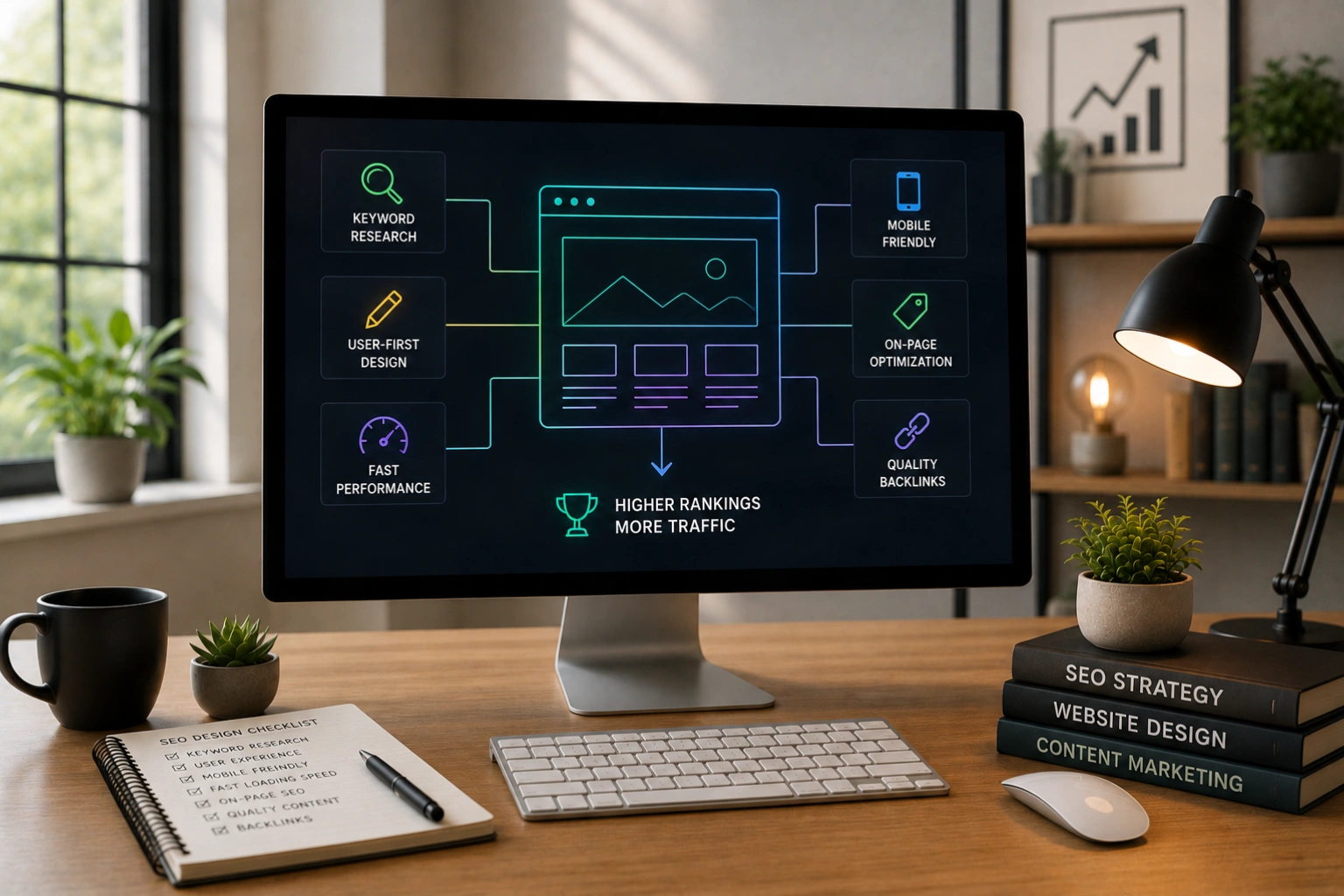
Ranking on Google is not just an SEO challenge; it is a design challenge. The structure of your site, the speed at which it loads, the clarity of its content hierarchy, and the quality of the experience it delivers all feed directly into how Google evaluates and ranks it. Designing for rankings and designing for users are not competing goals; they are the same goal.
There is a persistent misconception that SEO happens after design; that you build the website first and then optimize it for search. In practice, the most important SEO decisions are made during the design process, not after it. Page structure, URL architecture, heading hierarchy, internal linking, performance budgets, and mobile experience are all determined by design and development choices. Getting them right from the start is far more effective than retrofitting them onto a finished site.
At AG Art Studio, SEO considerations are embedded into every project from the first wireframe. Here is a practical guide to designing a website that is built to rank, covering the principles and decisions that matter most.
Start with site architecture, not visual design
The structure of your website; which pages exist, how they are organized, and how they link to each other, is the foundation on which everything else is built. Before any visual design begins, the site architecture should be mapped out with SEO in mind, because changing it after launch is disruptive and expensive.
Good site architecture serves two masters simultaneously: it makes the site easy for visitors to navigate, and it makes it easy for Google to crawl and understand. These goals almost always align. A logical, well-organized site that a first-time visitor can navigate intuitively is also a site that Google can crawl efficiently and categorize accurately.
Principles of SEO-friendly site architecture- Keep your most important pages within three clicks of the homepage; pages buried deep in the hierarchy receive less crawl priority and accumulate less internal authority
- Group related content into clear topic clusters; a services section with individual pages for each service, a blog organized by relevant categories, and a portfolio organized by project type all help Google understand what your site is about at a topic level
- Use a flat structure where possible; wide and shallow beats tall and deep for most business websites
- Ensure every page that should be indexed is reachable via at least one internal link; orphaned pages that exist but are not linked from anywhere else on the site are invisible to Google's crawlers
- Plan your URL structure before you build; clean, descriptive URLs such as yourdomain.com/services/web-design are more effective than yourdomain.com/page?id=247
Design for mobile first, index for mobile first
Google's mobile-first indexing means the mobile version of your website is the version that determines your search rankings. Designing mobile-first is therefore not just a UX best practice; it is an SEO requirement. A site designed primarily for desktop and adapted for mobile will almost always have a weaker mobile experience than one where mobile was the primary design consideration from the start. That weaker experience translates directly into weaker rankings.
Mobile-first design for SEO means ensuring that your mobile pages contain all the same content as your desktop pages. A common mistake is hiding content on mobile for layout reasons, collapsing sections behind accordions, or loading different content via JavaScript on smaller screens. Google evaluates the mobile version of your content; if important text, headings, or links are absent or inaccessible on mobile, that content does not count toward your rankings.
Build performance into the design from day one
Page speed and Core Web Vitals are confirmed ranking factors, and both are primarily determined by design decisions. Every element added to a page carries a performance cost: images, fonts, animations, embedded videos, third-party scripts, and plugins all add to the payload the browser must load before the page is usable. Designing with a performance budget in mind, rather than optimizing after the fact, produces significantly better results.
A performance budget is a set of limits applied to specific performance metrics during the design and development process. For example, committing to a maximum page weight of 1MB, a maximum of two custom font families, and a target LCP of under 2.5 seconds creates constraints that guide every subsequent design decision. These limits are not arbitrary; they are derived from the thresholds that correlate with good user experience and strong Core Web Vitals scores.
Practically, this means choosing lighter-weight image formats from the start, being deliberate about which fonts are loaded and how many weights are included, preferring CSS animations over JavaScript-driven ones, and evaluating every third-party script addition against its performance cost before implementing it.
Use semantic HTML throughout
Semantic HTML means using the correct HTML elements for their intended purpose; headings for headings, paragraphs for paragraphs, lists for lists, navigation elements for navigation, and article elements for article content. This matters for SEO because search engines use the semantic meaning of HTML elements to understand the structure and purpose of content. A page built entirely out of generic div elements with CSS classes for styling is structurally opaque to a search engine; a page built with semantic HTML communicates its structure clearly.
The practical implications include using a single H1 per page for the main topic, H2 headings for major sections, and proper list markup for any content that is genuinely list-like rather than simulating lists with styled paragraph elements. It also means using the nav element for navigation, the main element to identify the primary content area, and the article element for self-contained pieces of content such as blog posts. These are not obscure technical details; they are fundamental structural choices that affect how clearly Google can interpret your content.
Design content pages for topical depth and clarity
Google's ability to evaluate content quality has become increasingly sophisticated. Pages that rank well in 2026 tend to cover their topic comprehensively, answer the questions searchers are asking, and demonstrate expertise and authority. Design plays a role here that goes beyond aesthetics: the structure of a page, the way content is organized and presented, and the readability of the text all affect how deeply visitors engage with content and how completely Google can interpret it.
From a design perspective, content pages built to rank should have a clear, logical flow from introduction through key sections to conclusion. Each major section should correspond to a genuine subtopic related to the page's primary keyword. The heading structure should reflect this organization accurately. Content should be broken into digestible chunks with enough whitespace to be readable without effort. And the page should answer the question the searcher typed into Google, completely and honestly, rather than burying the answer behind self-promotional content.
Build internal linking into the design structure
Internal links serve two critical SEO functions: they help Google discover and crawl all of your pages, and they distribute authority from high-authority pages to pages that need a boost. A website designed without internal linking in mind produces pages that exist in isolation, each building authority independently with no help from the rest of the site. A well-designed internal linking structure turns your entire site into a network where authority flows where it is most needed.
Internal linking should be designed into the content architecture from the start, not added as an afterthought. Service pages should link to related case studies and blog posts. Blog posts should link to relevant service pages and to other related posts. The homepage should prioritize links to the pages you most want to rank. Footer navigation should include links to your most important pages. Related content sections at the bottom of blog posts provide contextual internal links while also extending visitor engagement.
Configure meta titles, descriptions, and structured data at build time
Every page on your website should launch with a unique, keyword-optimized meta title and a compelling meta description. These are not afterthoughts to be filled in later; they are part of the build. A meta title under 60 characters that includes the primary keyword for the page and communicates clearly what the page is about gives Google a strong relevance signal and gives searchers a clear reason to click. A meta description under 155 characters that accurately describes the page and includes a call to action improves click-through rates from search results.
Structured data markup, added in JSON-LD format, provides additional signals that can enhance how your pages appear in search results. Local businesses benefit from LocalBusiness schema. Articles benefit from Article schema. Service pages benefit from Service schema. FAQ content can be marked up to appear as rich results directly in the search page. These enhancements do not directly improve rankings but they improve visibility and click-through rates, which over time feed back into ranking performance.
Make crawlability a design requirement
Google cannot rank content it cannot find. Crawlability; the ease with which Google's bots can discover, access, and process all the pages on your site, should be a design requirement rather than an afterthought. Common crawlability failures include important content loaded exclusively via JavaScript without server-side rendering, navigation menus that rely on JavaScript interactions to reveal links, pages blocked from indexing by incorrect robots.txt rules, and redirect chains that make Google work unnecessarily hard to reach destination pages.
An XML sitemap submitted to Google Search Console tells Google which pages exist and should be indexed. A clean robots.txt file ensures that only pages you intend to exclude are blocked. Canonical tags prevent duplicate content issues when multiple URLs serve similar content. These are technical SEO basics that should be configured at launch, not discovered as problems months later when rankings fail to materialize.
A launch-ready SEO design checklist
Before any website designed to rank goes live, it should pass this checklist. Each item represents a design or build decision that directly affects search performance.
- Every page has a unique H1 that includes the primary keyword for that page
- Heading hierarchy is logical and consistent; H2 for major sections, H3 for subsections, no levels skipped
- Every informational image has descriptive alt text; decorative images have empty alt attributes
- Every page has a unique meta title under 60 characters and a meta description under 155 characters
- The site scores 75 or above on Google PageSpeed Insights for mobile performance
- All three Core Web Vitals pass the Good threshold on key pages
- Google Search Console shows no Mobile Usability errors
- An XML sitemap has been generated and submitted to Google Search Console
- The robots.txt file is correctly configured; no important pages are accidentally blocked
- Internal links connect all key pages to each other and to the homepage
- All URLs are clean, descriptive, and follow a consistent structure
- The site is served over HTTPS with a valid SSL certificate
- No intrusive interstitials or pop-ups obstruct content on mobile
- Structured data has been implemented for the site type; LocalBusiness, Article, Service, or FAQ as appropriate
- Google Analytics or an equivalent analytics tool is installed and verified
Ranking on Google is the result of many compounding decisions made correctly over time. The website that ranks is rarely the one that got lucky with a single tactic; it is the one that was designed thoughtfully, built cleanly, and maintained consistently. SEO-first design does not require compromising on aesthetics or user experience; in almost every case, what is good for search is good for users, and what is good for users is good for search. The two objectives are not in tension; they are the same objective, pursued from different angles.