

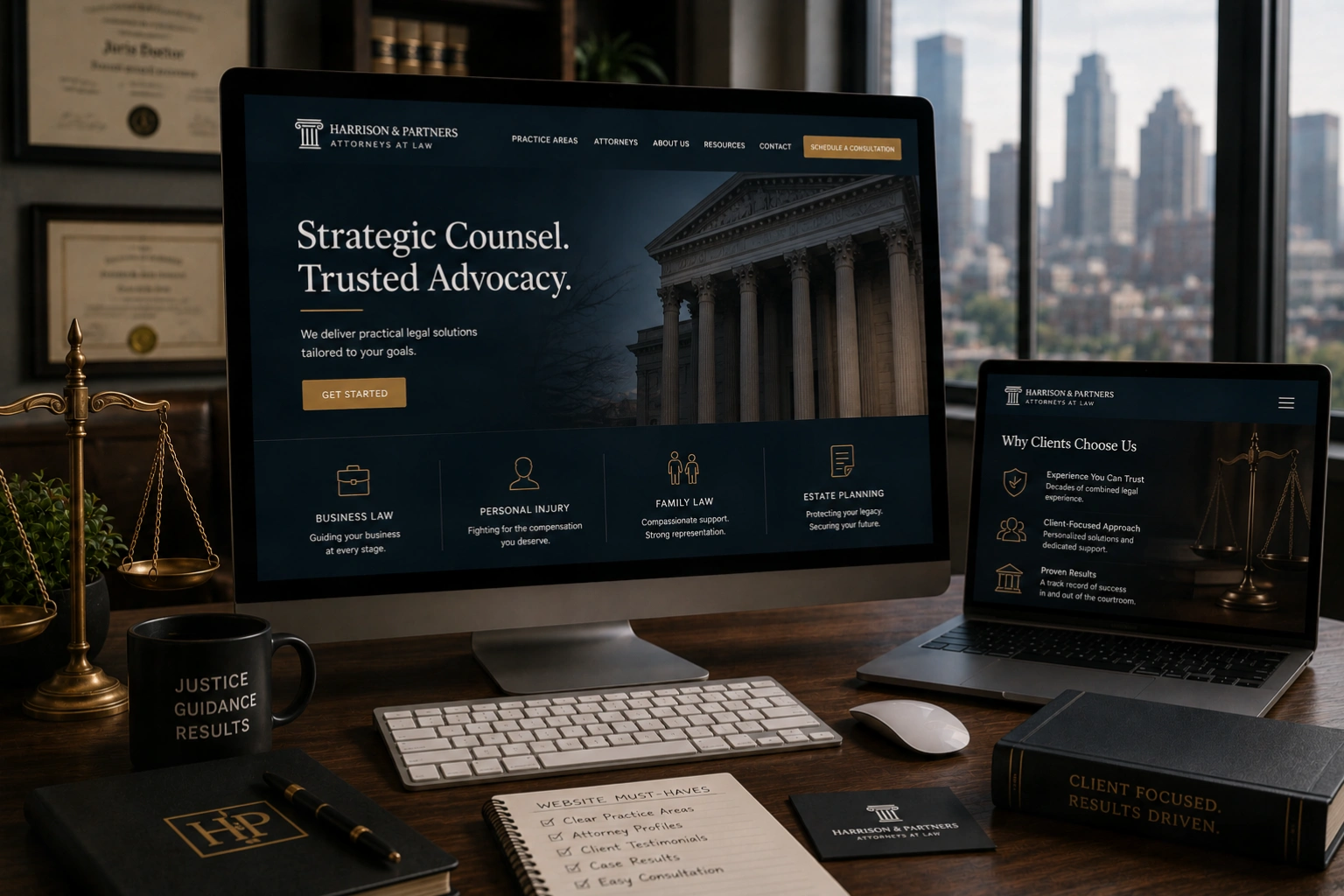
For most law firms, the website is the first point of contact a potential client has with the practice. It is where trust is established or lost, where expertise is communicated or obscured, and where the decision to pick up the phone is made or deferred. A law firm website designed without this reality in mind is a missed opportunity that compounds every single day.
Legal services are among the highest-trust purchases a person or business makes. The stakes are often significant: a family law matter, a business dispute, a criminal charge, an estate plan. Clients are not just looking for competence; they are looking for someone they feel safe trusting with something that matters enormously to them. The website is the first environment in which that trust is either established or undermined, and most law firm websites underestimate how much design and content contribute to that outcome.
At AG Art Studio, we have designed websites for legal practices across multiple specialisms. The principles that separate the websites that generate consistent, qualified enquiries from those that do not are clear and consistent. Here is a comprehensive guide to what law firm website design needs to get right in 2026.
Why law firm websites face a unique design challenge
Legal website design operates under constraints that most industries do not face. There are professional conduct rules around advertising and marketing that vary by jurisdiction and must be respected in how the firm presents itself and its services. There are confidentiality obligations that affect the kinds of case studies and testimonials that can be published. And there is the fundamental tension between communicating expertise and authority on one hand, and warmth and approachability on the other; qualities that clients in distress need simultaneously from whoever they choose to represent them.
The most effective law firm websites resolve this tension deliberately. They communicate rigorous expertise through their content, their structure, and their visual quality; and they communicate human understanding through their imagery, their tone, and the accessibility of their contact experience. Neither element alone is sufficient. A website that communicates only authority feels cold and unapproachable. A website that communicates only warmth risks feeling insufficiently professional for a high-stakes engagement.
The five pillars of an effective law firm website
Trust and credibility signals
In legal services, trust is not a nice-to-have; it is the product. Every element of your website should either build or preserve the confidence a potential client needs to pick up the phone. This means professional photography of your attorneys, not stock imagery of gavel-wielding hands. It means bar admissions and recognitions displayed clearly. It means client testimonials where professional rules permit them, and if they do not, alternative forms of social proof such as years in practice, case volume, or media appearances. It means a visual quality that matches the seriousness of the matters you handle.
The credibility signals that consistently perform best for law firm websites are specificity and recency. A vague statement like "we have helped thousands of clients" is far less persuasive than "over 1,400 successful family law matters since 2008." Specific numbers, named awards with their years, and recent publications or speaking engagements all tell a more convincing story than generic claims of expertise. If a prospective client is evaluating two firms with similar credentials, the one whose website communicates them more specifically and credibly will win the enquiry more often.
Clear, specific practice area pages
One of the most persistent weaknesses in law firm web design is the generic practice area page. A single page titled "Family Law" with three paragraphs of broad description serves neither the potential client nor the search engine. Clients searching for help with a specific situation, a contested divorce, a child custody dispute, or a prenuptial agreement, are looking for a firm that demonstrably understands their specific situation. A website that speaks in broad strokes signals that no one has thought carefully about what that particular client needs to hear.
The solution is dedicated pages for each meaningful sub-practice, written from the client's perspective rather than the firm's. A page about contested divorce should address the questions a person going through a contested divorce is actually asking: how long will this take, how much will it cost, what happens to the family home, how are custody arrangements determined. Answering these questions demonstrates expertise and builds confidence in a way that a generic description of divorce law simply cannot match.
From an SEO perspective, specific practice area pages also dramatically outperform generic ones. A page that targets "contested divorce lawyer in [city]" will rank for that search in a way that a generic "family law" page never will. The combination of client relevance and search visibility makes granular practice area pages one of the highest-return investments a law firm can make in its website.
Human presence and attorney profiles
People hire lawyers, not firms. The attorney profiles page is among the most visited on any law firm website, because potential clients want to know who they will be working with before they commit to a consultation. A profile that consists of a small headshot and a list of law school credentials is a missed opportunity. A profile that communicates the attorney's approach, their areas of genuine passion within their practice, their communication style, and something human about them as a person transforms a credentials check into the beginning of a relationship.
Professional photography for attorney profiles is non-negotiable at any firm positioning itself as quality. Natural-light photography with a genuine expression communicates far more approachability than a stiff studio headshot. Where possible, lifestyle photography of attorneys in their working environment, reviewing documents, meeting with a client, or engaged in the kind of work they do every day, adds depth and authenticity that a simple portrait cannot provide.
A law firm website is not a legal directory listing. It is the first conversation you have with a person who is worried, vulnerable, or under pressure. Design it with that person in mind, not with your credentials in mind.
Mobile performance and speed
Legal searches happen at moments of need; often on a mobile device, often outside business hours, and often in emotionally heightened circumstances. A person who has just been served divorce papers or received a call from the police does not have the patience for a slow, difficult-to-navigate website. The mobile experience of a law firm's website is not a secondary consideration; it is frequently the context in which the most motivated potential clients are making their decision about who to contact first.
Mobile performance for law firm websites means fast load times, a tap-to-call button that is immediately visible on every page, a contact form that is short and works perfectly on a touchscreen, and navigation that allows a stressed, distracted visitor to find the relevant practice area page within two taps. It also means that your most important trust signals, your Google review rating, your years of experience, your primary specialisms, are visible without scrolling on the mobile homepage.
Local SEO and search visibility
The majority of legal searches include a location modifier, whether typed explicitly or inferred by Google from the user's device location. "Personal injury lawyer near me" and "divorce attorney in [city]" are among the most commercially valuable searches in most legal markets. Appearing prominently for these searches requires a combination of an optimized Google Business Profile, location-specific content on your practice area pages, consistent NAP (name, address, phone) data across all directories, and active review generation from satisfied clients.
The Google Map Pack, the three local results that appear above organic search results for local queries, is the most valuable real estate in local legal search. Firms that appear in the Map Pack for relevant practice area searches receive a disproportionate share of enquiries, because they appear before organic results and carry the visual trust signal of Google's rating system. Earning and maintaining a Map Pack position requires ongoing attention to Google Business Profile optimization, review volume and quality, and the consistency of your local citation data across the web.
Content strategy for law firm websites
Beyond the core pages, a content strategy built around the questions potential clients are asking in search is one of the highest-leverage SEO and trust-building investments available to a law firm. People searching for legal help often begin with informational searches before they are ready to hire anyone: "how does child custody work," "what happens to debt in a divorce," "do I need a lawyer for a minor car accident." A law firm whose blog or resource section answers these questions authoritatively earns visibility at the top of the funnel and establishes expertise before the client is ready to make contact.
Legal content written for potential clients rather than for legal professionals strikes a difficult balance: it must be accurate and responsible while being written in language that a non-lawyer can understand and find valuable. Content that is too technical alienates the very audience it is trying to attract. Content that oversimplifies creates legal risk and credibility problems. The most effective law firm content educates clearly, acknowledges complexity where it exists, and ends by making clear that the specific circumstances of any individual matter require professional advice.
Design elements that are specific to law firm websites
Law firm color palettes should convey the qualities that define a trustworthy legal partner: reliability, seriousness, and competence. Deep navy blues, forest greens, warm charcoals, and rich burgundies all carry appropriate professional gravity. Bright, highly saturated palettes feel misaligned with the weight of most legal matters, though there are exceptions in practice areas serving younger demographics such as immigration or consumer rights. Whatever palette you choose, it should feel deliberate and consistent across every touchpoint, from the website to email signatures to reception area signage.
The photography on a law firm website communicates more about the firm's quality and culture than almost any other element. The minimum standard for any firm positioning itself as serious is professional photography for all attorney headshots, consistent against a clean background with consistent lighting and framing. The gold standard adds environmental photography of the office, candid shots of attorneys working or meeting with clients, and lifestyle imagery that conveys the accessibility and professionalism of the practice simultaneously.
Awards, recognitions, bar association memberships, peer ratings, and media appearances should be displayed prominently and specifically. A section on the homepage that shows recognitions with their logos and years, updated annually, provides instant visual validation of expertise without requiring a visitor to read several paragraphs to understand the firm's standing. Where professional rules restrict client testimonials, recognition from peer bodies and publications fills that trust-building function effectively.
The contact experience on a law firm website must reduce friction to near zero. A potential client who has worked up the courage to seek legal help should never have to hunt for a phone number, wait for a complex form to load, or wonder whether their message has been received. The phone number should be in the header on every page and tap-to-call on mobile. A simple contact form of no more than four fields should be available on every practice area page, not just the contact page. And the confirmation message after form submission should set clear expectations about response time.
Compliance and ethical considerations
Law firm websites in most jurisdictions are subject to professional conduct rules that govern how legal services can be advertised and how attorneys can represent their qualifications and prior outcomes. These rules vary by state, country, and practice area, but common requirements include disclaimers on case result information, restrictions on certain testimonial formats, and requirements around the use of terms like "specialist" or "expert." Any law firm redesigning its website should review the relevant professional conduct rules for its jurisdiction before publishing content, and should have the final website reviewed by someone familiar with those requirements.
- Review your jurisdiction's professional conduct rules for attorney advertising before publishing any case results or client testimonials
- Add appropriate disclaimers to case outcome information; most jurisdictions require language clarifying that past results do not guarantee future outcomes
- Ensure all attorney credentials listed are current and accurately represented
- Review the use of terms like "specialist," "expert," or "certified" against your jurisdiction's rules; many have specific requirements around these designations
- Confirm that your privacy policy covers how you handle data submitted through contact forms, including any consultation booking systems
Law firm website launch checklist
- Professional photography for all attorneys with consistent framing and lighting
- Dedicated page for each meaningful practice area sub-specialism, written from the client's perspective
- Attorney profiles that go beyond credentials to communicate approach, personality, and working style
- Tap-to-call phone number visible in the header on every page
- Short contact form on every practice area page, not only on the contact page
- Google review rating or equivalent social proof displayed on the homepage above the fold
- Mobile PageSpeed score above 70 and no mobile usability errors in Search Console
- Google Business Profile fully completed, verified, and linked to the website
- LocalBusiness and LegalService schema markup implemented and tested
- Unique meta titles and descriptions for every page, including each practice area page
- Content reviewed against relevant professional conduct rules for attorney advertising
- Google Analytics and Search Console installed and confirmed
A law firm website that gets these fundamentals right becomes one of the practice's most productive business development assets. It works around the clock, reaching potential clients at exactly the moments of need when they are most motivated to act. It communicates expertise and humanity simultaneously. It ranks well for the local searches that drive the highest-quality enquiries. And it makes the process of reaching out feel easy rather than daunting; which, for the clients who need legal help most urgently, can make the difference between a call that leads to a new client and a visit that ends in silence.