

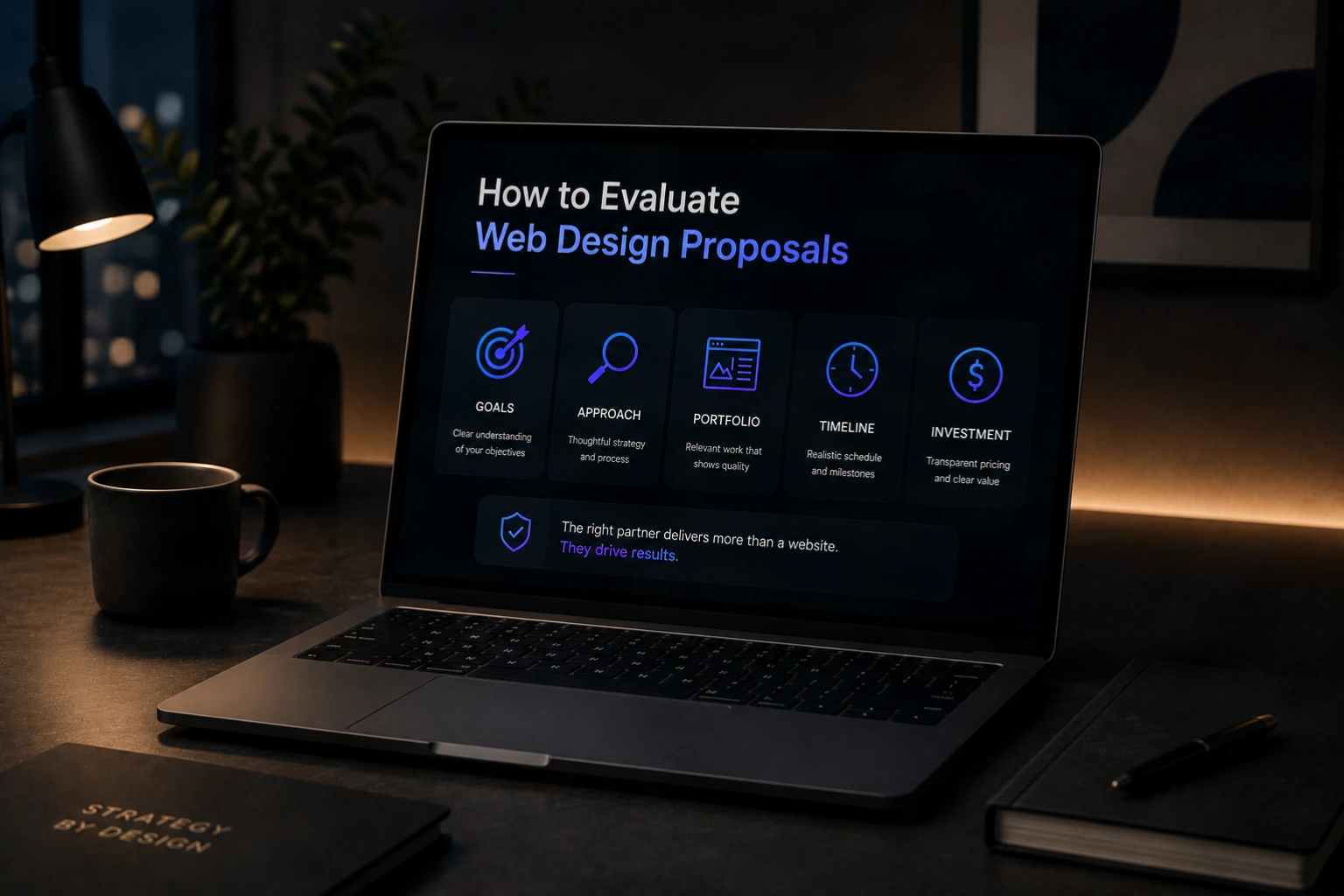
Receiving a web design proposal can feel like reading a foreign language. The language of deliverables, retainers, CMS platforms, and revision rounds is unfamiliar to most business owners, and that unfamiliarity creates risk: the risk of choosing based on price alone, misunderstanding what is included, or committing to a provider whose process will frustrate you from week two onwards. Here is how to read a proposal like an expert.
Most businesses request two or three proposals when considering a web design project. The problem is that without a framework for evaluating them, the comparison defaults to price, and price alone is a deeply unreliable proxy for value in web design. A cheaper proposal that excludes content, post-launch support, and SEO setup may ultimately cost more than a more expensive one that includes all three. A proposal that looks comprehensive but lacks specificity about who does the work and what happens when things go wrong is not comprehensive at all.
At AG Art Studio, we have seen every variation of web design proposal, from half-page emails to fifty-page documents. Here is a practical, section-by-section guide to evaluating any proposal you receive, identifying what it is actually telling you, and asking the right questions before you sign.
Anatomy of a web design proposal
A strong proposal answers questions you have not yet thought to ask. Gaps in any section are gaps in the working relationship that follows.
How to read each section of a web design proposal
The project overview: do they understand your brief?
A well-written proposal opens with a summary of the project that reflects genuine understanding of your brief. It should describe your business accurately, articulate the core problem the website is being built to solve, and demonstrate that the provider has absorbed the goals and constraints you shared. A proposal that opens with generic language about "building a modern, responsive website that reflects your brand" and could apply to any client in any industry is a proposal written by someone who has not engaged seriously with your brief. This section is the first and clearest signal of the quality of thinking behind everything that follows.
Scope and deliverables: what is actually included?
This is the most consequential section of any proposal, and the one most often written ambiguously. The scope defines exactly what you are paying for: which pages will be designed, which functionality will be built, whether copywriting is included or excluded, whether photography is in or out of scope, whether SEO setup is included or treated as a separate engagement, and whether analytics configuration is part of the project. Every item that is not explicitly in scope is implicitly out of scope; and any work that turns out to be needed but was not scoped will either be declined or charged as an extra.
Read the scope section with this question in mind: if I took this list of deliverables to launch day, would I have a complete, publishable website? If the answer is "not without also having copy, photography, and SEO setup that are not mentioned anywhere," those items need to be either added to the scope or explicitly agreed as client responsibilities before you sign. Ambiguity in the scope section is the primary source of surprise charges and scope disputes in web design projects.
Timeline and milestones: is this realistic?
A timeline that includes specific milestones with defined deliverables and client review checkpoints signals a provider who has managed projects before and understands that clear structure protects both parties. A timeline that simply says "project will be completed in six to eight weeks" with no breakdown of phases or dependencies is a timeline that cannot be held to. Realistic timelines for a custom business website are typically six to ten weeks from kickoff to launch; timelines significantly shorter than this for a complex scope should be interrogated, as should timelines significantly longer with no explanation of what takes the additional time.
Pricing and payment structure: read this twice
Pricing section transparency tells you a great deal about how a provider operates. A proposal that itemizes costs by phase or by deliverable makes it straightforward to understand what drives the total and to compare proposals on an equivalent basis. A proposal that presents a single total with no breakdown makes comparison difficult and disputes about changes more likely. The payment schedule also matters: a typical structure is 30 to 50% upfront, a payment at a mid-project milestone such as design approval, and the balance on launch. A provider who asks for 100% upfront is asking you to carry all the risk; one who asks for nothing until completion is carrying risk themselves and may have cash flow concerns worth understanding.
The cheapest proposal in a competitive review is rarely the best value. It is usually the one where the most has been left out of scope, the most corners will be cut, or the least experienced team will be doing the work.
Process, revisions, and change management
How a provider manages revisions and scope changes is one of the clearest indicators of how the working relationship will feel in practice. A proposal that clearly states the number of revision rounds included at each phase, what constitutes a revision versus a scope change, and how out-of-scope work is priced and approved is a proposal written by a provider who has navigated these situations before and knows how to manage them professionally. A proposal that says nothing about revisions, or uses language like "unlimited revisions," warrants direct clarification: unlimited revisions to what, and by what definition of a revision?
Post-launch support and ongoing relationship
What happens after the website goes live is a question many clients do not think to ask until they need help with something and find themselves without a clear path to get it. A quality proposal addresses post-launch explicitly: a warranty period during which bugs are fixed without additional charge, the availability and cost of ongoing maintenance, how content updates are handled, and who owns the domain, hosting account, and website files. If the proposal is silent on what happens after launch, ask directly; the answers will tell you whether you are looking at a provider interested in a long-term relationship or one interested in closing the project and moving on.
Comparing proposals side by side
When you have received multiple proposals, the comparison framework below helps move the evaluation beyond price and toward genuine value assessment.
| Evaluation criterion | Green flag | Red flag |
|---|---|---|
| Project understanding | Brief is reflected accurately and specifically | Generic language that could apply to any client |
| Scope detail | Every deliverable named and described explicitly | Vague deliverables with no itemization |
| Content responsibility | Clearly states what client provides vs. what studio creates | No mention of content; assumes it appears by itself |
| Timeline structure | Phase-by-phase with milestones and review points | Single "completed in X weeks" with no breakdown |
| Revision policy | Number of rounds stated; scope change process defined | "Unlimited revisions" with no definition |
| Payment structure | Split across milestones; itemized by phase | 100% upfront or single lump sum on completion only |
| SEO and performance | SEO setup, speed optimization explicitly included or excluded | No mention of either; assumed or ignored |
| Asset ownership | Client owns domain, hosting, and all files on final payment | Unclear or silent on ownership; provider retains control |
| Post-launch support | Warranty period defined; maintenance options available | No mention of what happens after launch |
Questions to ask before you sign any proposal
- Who specifically will be designing and developing this project, and what is their experience level? Will the person I meet in the sales process be involved in the actual work?
- What happens if the project runs over the agreed timeline? Is there a process for addressing delays, and who is responsible for them?
- What does a revision round consist of? How many changes can I request within a single round, and what triggers an additional charge?
- Is copywriting included, and if so, does that cover all pages in the scope or only selected ones?
- What platform will the website be built on, and what are the long-term implications for my ability to manage, update, and migrate the site?
- Who owns the domain name, the hosting account, and all design and code files on completion of the project?
- What does the post-launch relationship look like? Is there a warranty period, and what does it cover?
- How is SEO handled in this build? What technical SEO foundations are included, and what would require a separate engagement?
- Can you provide two or three references from recent clients at a similar project scale, whom I can contact directly?
When a lower-priced proposal is the right choice
Choosing the lowest-priced proposal is not always the wrong decision. There are genuine circumstances in which a lower-cost option represents good value: early-stage businesses that need a functional online presence without a large investment, projects with a straightforward scope and low complexity, and cases where the lower-priced provider has a strong portfolio of relevant work and credible references at that price point.
The issue is not the price itself but the gap between what the price implies and what is actually being provided. A $4,000 proposal that includes a clearly scoped five-page website, defined revision rounds, client-supplied content, and post-launch support is a transparent and potentially fair offer. A $4,000 proposal that vaguely promises a "complete website solution" with no scope detail, no content plan, and no mention of what happens after launch is a proposal that is almost certain to produce disappointment regardless of the price.
- The scope lists every deliverable explicitly, including which pages will be designed and built
- Content responsibilities are clearly assigned; you know what you need to provide and when
- The timeline includes specific milestone dates with defined review and approval points
- The revision policy states exactly how many rounds are included and what constitutes a round
- The payment schedule is spread across milestones rather than concentrated entirely upfront or at completion
- You know who will be doing the design and development work, not just who sold the project
- The proposal confirms that you will own your domain, hosting account, and all files on final payment
- Post-launch support is addressed; you know what happens if something breaks in the first month
- You have spoken to at least one reference from a recent, comparable project
- You understand what is explicitly excluded from scope and have a plan for those items
A web design proposal is a business document that carries real legal and financial weight once you sign it. Taking the time to read it carefully, ask the questions it raises, and compare it against other proposals with a structured framework is not excessive due diligence; it is the basic investment of care that a decision of this significance deserves. The hour you spend evaluating proposals thoroughly is almost always less expensive than the months you might spend managing a project that went wrong because the proposal was read too quickly.