

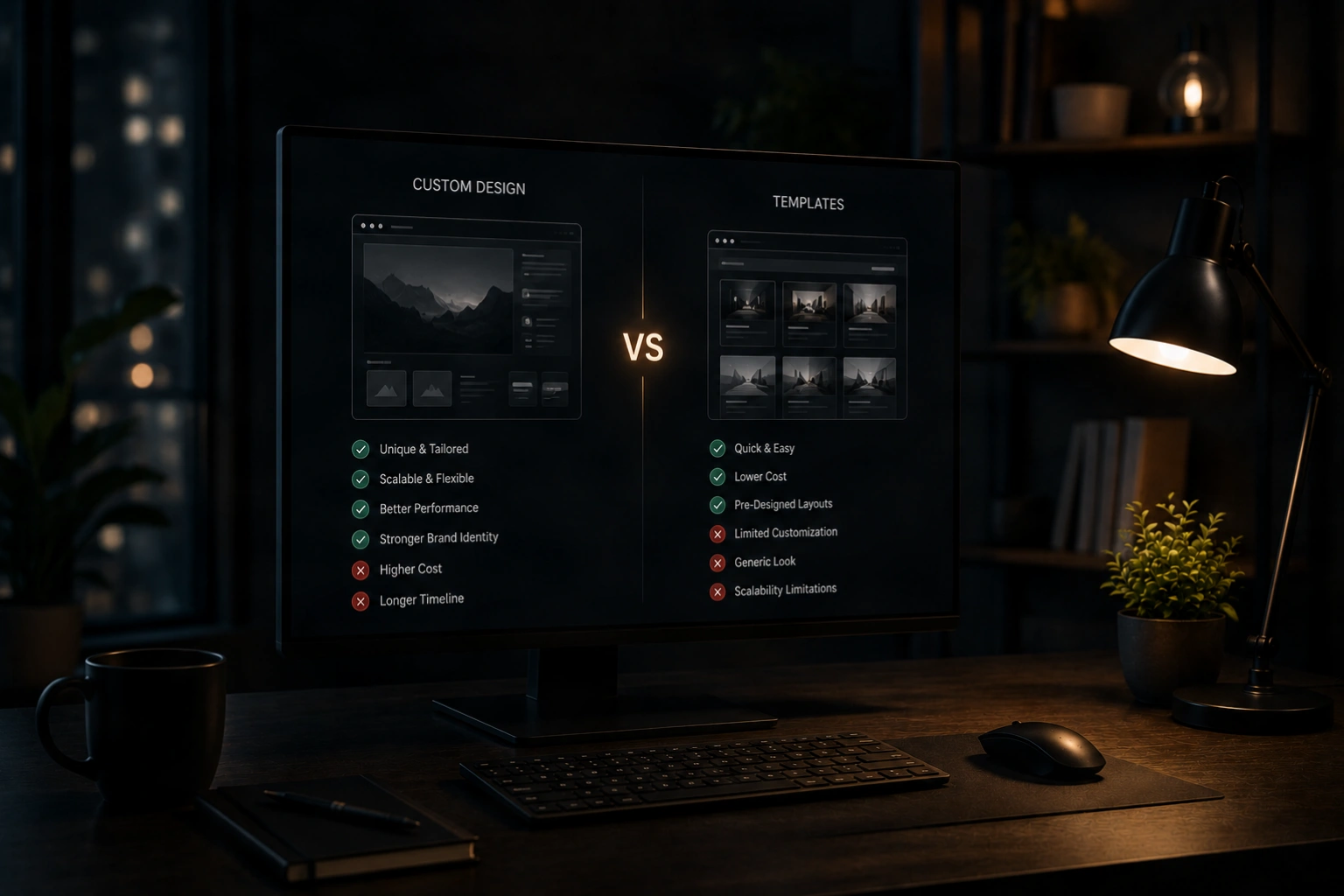
Custom design or a template — it is one of the most consequential decisions you will make when building a new website. Both options have real merits and real limitations, and the right choice depends on your business, your budget, and where you want to be in three years. Here is an honest breakdown of both sides.
The debate between custom and template is not as simple as "custom is better." Templates have matured significantly — some of the best WordPress themes and Webflow templates are genuinely impressive, well-coded, and fast. At the same time, custom design offers something templates fundamentally cannot: a website built entirely around your business, your brand, and your specific goals.
Understanding the real differences — not just the marketing pitch for each approach — is the starting point for making the right call. At AG Art Studio, we build both, and we recommend honestly based on what each client's situation actually calls for. Here is what we have learned.
What a website template actually is
A website template — also called a theme — is a pre-built design framework that defines the visual structure of a website. Templates include pre-designed page layouts, typography settings, color schemes, navigation structures, and often a library of reusable section blocks. The designer or business owner customizes these with their own content, colors, and branding to create a finished site.
Templates exist for every major platform: WordPress, Webflow, Squarespace, Shopify, and others. Quality ranges enormously — from free themes that are barely maintained to premium templates costing several hundred dollars that are professionally designed, regularly updated, and optimized for performance.
The key thing to understand about templates is that they are designed to work for everyone, which means they are not designed specifically for anyone. The layout decisions, the section structures, the navigation patterns — all of these were made by someone who had no knowledge of your business, your audience, or your goals. That generality is both the strength and the limitation of the approach.
What custom web design actually means
Custom web design means your website is designed from scratch, specifically for your business. There is no pre-existing template as a starting point — the designer begins with your brand, your goals, your audience, and your content, and builds a visual and structural system around those specifics.
This does not mean every element is coded by hand from a blank file. Custom design often uses established development frameworks, component libraries, and CMS platforms like WordPress or Webflow as the technical foundation. What makes it custom is the design layer — the visual decisions, the UX architecture, the content hierarchy, and the brand expression are all created specifically for you.
The output is a website that looks and works like no other. The navigation reflects your specific user journeys. The visual identity is entirely yours. The page structures are built around your content rather than your content being squeezed into pre-existing structures.
Comparing the two approaches directly
| Factor | Template | Custom design |
|---|---|---|
| Cost | Lower — template cost plus designer's customization time | Higher — full design and development from scratch |
| Timeline | Faster — 2 to 5 weeks for most projects | Longer — 6 to 12 weeks for a thorough build |
| Visual uniqueness | Limited — shared with other sites using the same theme | Complete — entirely yours, built from the ground up |
| Performance | Variable — depends heavily on the theme's code quality | Optimized — built lean with only what your site needs |
| Flexibility | Constrained — within the limits of what the template allows | Unlimited — anything can be designed and built |
| SEO foundation | Depends on template quality — some are well-optimized, many are not | Built to spec — structured data, clean code, optimized from launch |
| Brand differentiation | Moderate — customization helps but template DNA remains | Maximum — visually distinct in any competitive landscape |
| Maintenance | Theme updates required — can sometimes break customizations | Stable — no third-party theme dependency |
| Best for | Early-stage businesses, limited budgets, fast launch requirements | Established businesses, competitive industries, brand-led positioning |
The real advantages of templates
Speed to market
A template-based website can be live in weeks rather than months. For a business that needs an online presence quickly — to support a product launch, a new service offering, or a funding pitch — a well-executed template site is a perfectly legitimate choice. Getting something professional online fast has genuine business value, and templates make that possible at a fraction of the custom build timeline.
Lower upfront investment
Templates significantly reduce design time, which directly reduces cost. For businesses with limited budgets, a quality template executed well by an experienced designer delivers far more value than a poorly executed custom site. The template handles the structural design work; the designer's job is customization, content strategy, and ensuring the execution is clean and on-brand.
Proven design patterns
Premium templates from reputable marketplaces have been tested across thousands of websites and iterated based on real-world performance. The navigation patterns, section structures, and layout logic embedded in a good template often reflect genuinely sound UX thinking. You are not starting from scratch with untested design decisions — you are building on a foundation that has already been validated.
The real limitations of templates
You share your visual identity with thousands of others
The most popular WordPress themes are used by tens of thousands of websites. Even with customization — different colors, different fonts, different imagery — the underlying structural DNA of the template remains visible to a trained eye. In competitive industries where visual differentiation is a purchasing signal, this shared origin is a meaningful limitation. Your website risks looking like a variation of your competitors' websites rather than a distinct expression of your brand.
Performance can be harder to control
Many popular WordPress themes load significant amounts of CSS, JavaScript, and third-party scripts that your specific site does not need — because the theme is built to support every possible use case. This bloat can drag down page speed and Core Web Vitals scores. While experienced developers can mitigate this through careful configuration, it is an ongoing constraint that custom-built sites do not face in the same way.
Your content fits the template, not the other way around
Templates impose a structure. Your content — your story, your services, your unique value proposition — has to fit within the sections, layouts, and hierarchy that the template provides. Sometimes this is fine. But often, the most compelling way to present a particular business's story does not map neatly onto a generic template structure. Custom design starts from the content and builds the structure around it, which almost always produces a more coherent and persuasive result.
Theme updates can break your customizations
Template-based sites depend on the theme being maintained by its developer. When theme updates are released — which is necessary for security and compatibility — they can sometimes conflict with customizations made to the template. Managing this over time requires ongoing attention and occasional remediation work. Custom-built sites do not have this dependency.
The real advantages of custom design
Complete visual and structural ownership
A custom website is entirely yours. Every design decision — the layout, the typography, the color system, the interaction patterns, the content hierarchy — was made specifically for your business with full knowledge of your brand and your goals. No other website in the world has the same design DNA. This distinctiveness is a genuine competitive asset in any industry where first impressions influence purchasing decisions.
Built for performance from the ground up
Custom-built sites include only the code, styles, and scripts they actually need. There is no template bloat, no unused CSS, no JavaScript loaded for features that are not in use. This leanness translates directly into faster load times, better Core Web Vitals scores, and stronger SEO performance — all of which compound over time as the site accumulates traffic and rankings.
Designed around your user journeys
Custom design begins with understanding how your specific users arrive at your site, what they are looking for, and what action you want them to take. The navigation, the page structures, the calls to action, and the content hierarchy are all designed around those specific journeys — not adapted from a generic framework. The result is a website that guides visitors more effectively toward conversion because it was built with that goal as the primary design constraint.
Which is right for your business?
The most honest answer is that it depends on where your business is and what your website needs to do. Here is a practical framework for making the decision.
Choose a template if- You are early-stage and need a professional presence quickly without a large upfront investment
- Your website is primarily informational and does not need to work hard as a conversion tool
- You are testing a business concept and want to validate it before committing to a full custom build
- You have a tight timeline with a fixed launch date that custom design cannot accommodate
- Your industry is not highly competitive visually and differentiation through design is less critical
- Your website is a primary revenue channel and its performance directly affects business results
- You are in a competitive industry where visual quality and brand distinctiveness influence purchasing decisions
- You want a website that will serve your business for five or more years without fundamental structural limitations
- Your content and user journeys are specific enough that a generic template structure will not serve them well
- You are positioning your business as a premium provider and your website needs to reflect and reinforce that positioning
- You have specific functionality requirements that template platforms cannot accommodate cleanly
A third option worth considering
For businesses that want more than a template but are not ready for a full custom build, a middle path exists: a premium template executed with genuine expertise. This means selecting a high-quality, well-coded template and having an experienced designer customize it thoroughly — restructuring sections where needed, building custom components, optimizing performance, and ensuring the visual result feels genuinely on-brand rather than template-derived.
Done well, this approach can produce a website that looks and functions far closer to a custom build than a typical template job — at a cost point between the two extremes. The key is working with a designer who treats the template as a starting point for creative problem-solving rather than a kit to be assembled unchanged.
Whatever path you choose, the most important thing is to make the decision based on your actual business situation — your goals, your audience, your competitive landscape, and your budget — rather than on a general preference for one approach over the other. Both can work. Both can fail. The difference is almost always in the execution.