

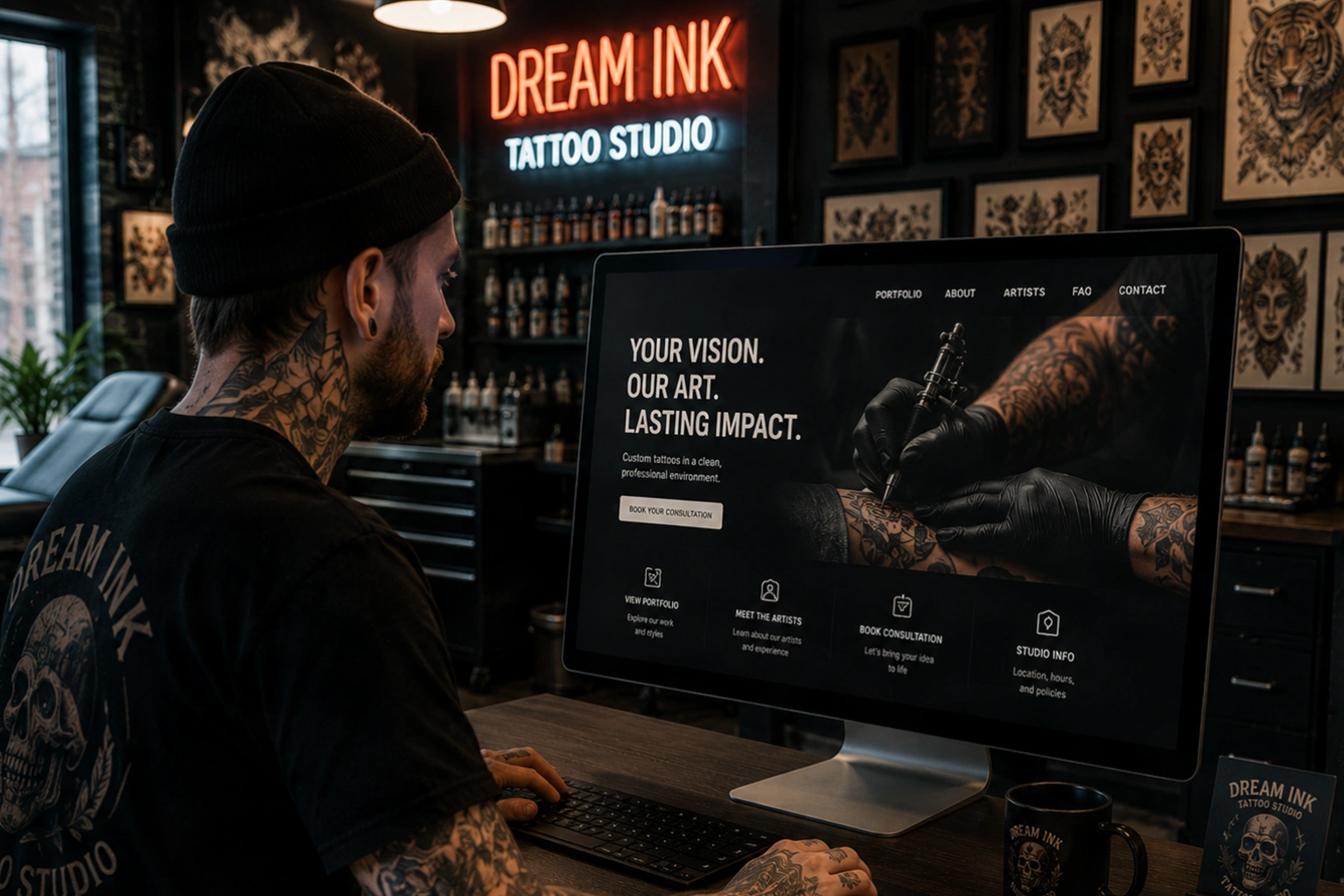
Getting a tattoo is one of the most personal purchasing decisions a person makes. They are choosing someone to permanently mark their body with something that matters to them, often something deeply significant. The stakes are high, the anxiety is real, and the trust required before they commit is substantial. That trust is built almost entirely online before a client ever walks through your door, and the website is where most of that trust is either earned or lost. A tattoo studio without a website that does this work properly is not just leaving bookings on the table. It is leaving them for the studio down the street whose online presence inspires the confidence yours does not.
The tattoo industry has a complicated relationship with its own digital presence. Studios that produce extraordinary work often have websites that do it no justice, relying instead on Instagram as a primary channel with a link-in-bio that leads to a contact form and little else. Instagram is powerful for discovery and for building a following, but it is not a website. It cannot answer the questions a first-time client needs answered before they book, it cannot explain the process to someone who has never had a tattoo, and it cannot build the layer of trust that converts someone who admires the work into someone confident enough to commit to an appointment.
At AG Art Studio, we understand what it takes to build trust online for personal, high-stakes services. Here is exactly what a tattoo studio website needs to do, and what most of them are getting wrong.
What a tattoo studio website needs to do
Present the portfolio as the centrepiece, not an afterthought
A tattoo is a visual product and the portfolio is everything. Not a grid of small thumbnails that require clicking through to see properly, not a gallery that mixes styles indiscriminately, and not a collection of phone photos taken under fluorescent lighting. The portfolio needs to be front and centre, photographed properly on healed skin where possible, organised by style so a client looking for fine line work can find fine line work without scrolling through bold traditional pieces, and presented at a size that does justice to the detail. A studio with multiple artists needs individual portfolio sections for each artist so clients can find the person whose work specifically resonates with them. The portfolio is not supporting content. It is the primary conversion tool on a tattoo studio website and it should be designed and maintained accordingly.

Answer the questions first-time clients are too nervous to ask
A significant proportion of people considering their first tattoo do not book because their questions go unanswered and the anxiety of the unknown outweighs their desire. Does it hurt? What happens if I am not happy with the design? How do I prepare? How long does it take? What does the healing process look like? What is your process for custom designs? A well-structured FAQ or process page that addresses these questions openly and specifically does three things simultaneously: it removes the barrier to booking for anxious first-timers, it signals that the studio is approachable and communicative, and it reduces the volume of repetitive pre-booking enquiries that consume artist time. Studios that answer these questions proactively convert significantly more first-time visitors than those that leave them to find answers elsewhere, which often means they find a competitor who provides them instead.
Introduce every artist as an individual with a distinct identity
People book tattoo artists, not tattoo studios. The relationship between client and artist is deeply personal, and the decision about who to trust with a permanent piece of work on their body is one of the most intimate choices in any creative service. A studio website that presents its artists as a nameless collective with a shared portfolio is missing the most powerful conversion lever available to it. Each artist needs their own page: a genuine biography that explains their background, what drew them to tattooing, the styles they specialise in, and what a session with them is like. Real photos of the artist at work. Their individual portfolio. Links to their personal Instagram. A booking mechanism specific to them. The more a potential client feels they know and understand an artist before making contact, the lower the barrier to booking and the higher the quality of the resulting client relationship.
 Photo by AI25.Studio on Pexels
 Photo by AI25.Studio on Pexels
Make the booking process clear, structured, and low-friction
The booking flow on most tattoo studio websites is a black box. A visitor who wants to book is directed to a generic contact form with no guidance about what information to include, no indication of how long the process takes, no sense of what happens next, and no timeline for a response. This uncertainty is a significant conversion barrier. A well-designed booking flow tells the client exactly what information the artist needs, such as the placement, size, style reference, and any reference images, sets clear expectations about response times and the consultation process, and confirms that their submission has been received. Some studios use dedicated booking tools like Setmore or Vagaro that handle deposits and confirmations automatically. The key is that the client never feels like their enquiry has gone into a void, because that feeling reliably produces silence rather than a booked appointment.
Use client stories and healed photos to build the trust stock images cannot
Fresh tattoo photos taken immediately after a session are the standard portfolio format, but they tell only part of the story. Healed photos, showing how the work looks after the skin has settled and the colours have matured, are significantly more persuasive to a cautious first-time client because they show the real, lasting result rather than the ideally-lit in-session version. Client testimonials that describe the experience, not just the outcome, address the emotional concerns that visual portfolios cannot: was the artist patient with someone who was nervous? How did they handle a client who was not sure exactly what they wanted? What was the aftercare guidance like? These narrative reviews, displayed alongside the completed work they describe, are the closest thing a website has to a personal recommendation from a trusted friend, which is the strongest possible conversion tool in a high-trust service business.
Win local search so new clients can actually find you
Most tattoo bookings are local. A client willing to travel two hours for a specific artist exists, but the majority of new client acquisition happens through local discovery: someone searches "tattoo studio near me" or "best fine line tattoo artist in [city]" and books from the results they find. A tattoo studio website that does not contain clear location signals, that does not mention the city and neighbourhood it operates in throughout its content, and that is not properly connected to a complete and verified Google Business Profile is invisible to those searches regardless of how good the work is. Local SEO for a tattoo studio is not complicated, but it is consistently neglected, which means the studios that do it properly gain a significant and durable advantage in local search visibility over those that do not.
 Photo by Maor Attias on Pexels
A tattoo client is not just choosing a design. They are choosing a person to trust with something permanent. The website's job is to make that trust feel earned before the first conversation even begins.
Tattoo studio website elements by booking impact
| Element | Booking impact | Most studios have it? | Priority |
|---|---|---|---|
| High-quality portfolio by style | Very high | Rarely done well | Highest |
| Individual artist profiles | Very high | Almost never | Highest |
| First-timer FAQ and process page | High | Almost never | Highest |
| Structured booking flow | High | Sometimes | High |
| Healed photos alongside fresh work | Medium-high | Rarely | High |
| Client testimonials with specifics | Medium-high | Rarely placed well | Medium |
| Local SEO content and Google profile | Medium | Almost never | Medium |
| Aftercare and preparation guides | Medium | Rarely | Medium |
The most common website mistakes tattoo studios make
 Photo by cottonbro studio on Pexels
 Photo by jasmin chew on Pexels
What to prioritise when building or updating your studio's website
- The portfolio is front and centre on the homepage with high-resolution images photographed under proper lighting
- Portfolio work is organised by style so clients can navigate directly to the aesthetic that matches what they want
- Each artist has their own dedicated profile page with a biography, individual portfolio, and a booking mechanism specific to them
- Healed photos are included alongside fresh work to show how pieces look after the skin has settled
- A first-timer page or FAQ addresses the most common anxieties about the process, pain, preparation, and aftercare
- The booking flow tells clients exactly what information to include, sets expectations about response times, and confirms their submission
- Client testimonials describe the experience of the session, not just the quality of the outcome
- The studio's city, neighbourhood, and nearby landmarks are mentioned naturally throughout the site content
- The Google Business Profile is fully completed, verified, and linked to the website with consistent name, address, and phone number
- The phone number and booking link are immediately visible on mobile without scrolling
- The site loads in under three seconds on a mobile connection and all portfolio images are compressed without visible quality loss
- An aftercare guide is available on the site so clients have a reference resource after their session
The tattoo studios consistently generating waitlists and turning away work are not necessarily the ones with the most talented artists. They are the ones whose entire online presence — website, Google profile, Instagram, and the connection between all three — communicates quality, builds trust, and makes the decision to book feel easy rather than risky. The art is what keeps clients coming back and generating referrals. The website is what converts a stranger who has just discovered the work into someone confident enough to take the first step. Both matter, and the studios that invest in both build a commercial position that compounds over time into something their competitors find very hard to close.
Showing a minimum session rate or a starting price is almost always worth doing, because it pre-qualifies visitors and prevents enquiries from people whose budget does not match your rates. Most studios charge by the hour or by the piece with significant variation depending on size, complexity, and placement, which makes exact pricing difficult to display. The best approach is to show your hourly rate or minimum session fee alongside a clear explanation that final pricing depends on the specific piece, and to invite visitors to submit a booking request with their idea so you can provide an accurate quote. Hiding pricing entirely tends to attract more low-budget enquiries rather than fewer, because visitors assume the worst and only those with no budget concern proceed.
Very important, particularly for first-time clients. A clean, well-lit, professional-looking studio space signals hygiene and professionalism before a word is read. First-time clients in particular are concerned about the environment they will be sitting in for several hours, and a photo of the actual studio removes a significant anxiety that they would otherwise carry into the booking decision. Studios operating from home or shared spaces should be honest about this rather than hiding it, as clients who discover the reality after booking feel misled, whereas clients who know in advance and still book are genuinely comfortable with the arrangement.
A waitlist built entirely through Instagram is a single point of failure. Algorithm changes, account restrictions, or platform shifts can reduce your reach overnight without warning, and you have no owned channel to fall back on. A website gives you a booking system you control, a Google presence that generates discovery independently of social media, and a professional credential that supports premium pricing. Additionally, a well-built website often improves the quality of enquiries you receive even when the volume is already high, because it answers questions upfront and filters for clients who are genuinely aligned with your work and your rates before they ever make contact.
The most common approaches are booking platforms like Vagaro, Booksy, or Square Appointments, which handle deposit collection, appointment confirmations, and reminder messages automatically as part of the booking flow. For studios that prefer a simpler approach, a structured enquiry form followed by an invoice for a holding deposit via Stripe or PayPal works well. The key is that the deposit is collected before the appointment is confirmed in the calendar rather than on the day, which reduces no-shows significantly and ensures that the time investment in design work before a session is protected. Any deposit policy should be clearly stated on the website so clients understand the terms before they submit a booking request.
The portfolio should be updated at minimum monthly, and ideally as soon as notable new pieces are completed and properly photographed. Artist pages should be updated whenever a team member joins, leaves, or significantly develops their style. Booking availability, pricing, and studio information should be updated immediately whenever anything changes. Google rewards websites that show regular signs of activity, and a portfolio that reflects your current standard and aesthetic direction is significantly more persuasive to a new visitor than one that shows where you were two or three years ago. A simple workflow of photographing strong new work immediately after completion and publishing it within a few days keeps the site fresh without requiring significant ongoing effort.
A professionally built tattoo studio website with custom design, individual artist pages, a structured portfolio system, a booking flow, a first-timer FAQ, local SEO foundations, and mobile-first build typically costs between $3,500 and $9,000 depending on the number of artists and the complexity of the booking integration. Portfolio photography, if not already available, should be budgeted separately at $400 to $1,200 for a focused shoot covering multiple pieces across artists. Ongoing hosting and maintenance should be budgeted at $80 to $150 per month. Given that a single tattoo session can generate $300 to $1,500 or more in revenue, a website investment that generates even two or three additional bookings per month pays back within the first few weeks of launch and continues compounding value for years.