

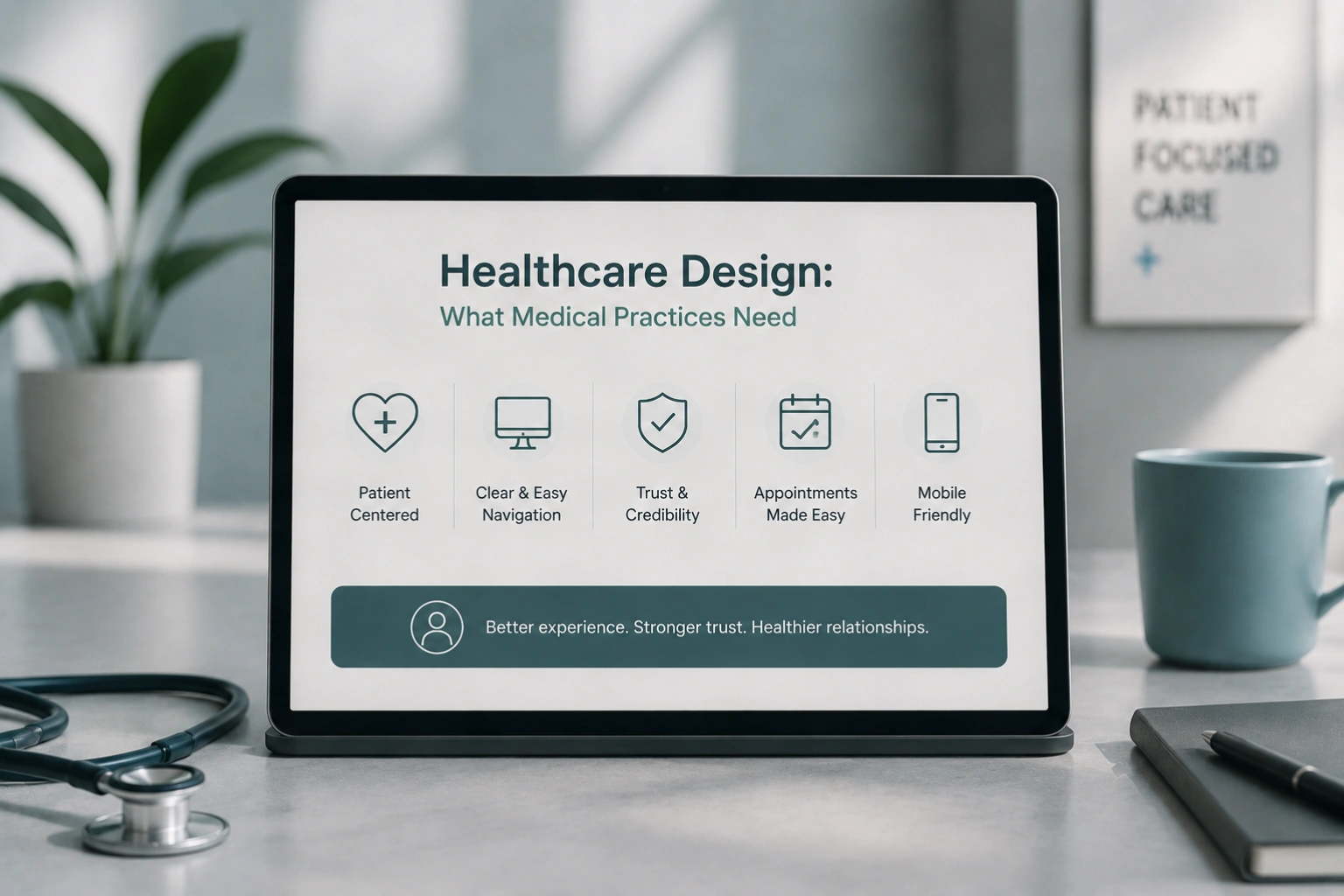
A healthcare website carries a weight that most industry websites do not. Patients arrive on it at moments of vulnerability; worried about symptoms, researching a diagnosis, or trying to choose a provider for something that matters deeply to them. The design decisions made on that website either ease that experience or compound the anxiety. There is no neutral ground.
Medical practices, clinics, and healthcare providers face a unique combination of design challenges. They must communicate clinical competence while feeling warm and human. They must make it easy to book an appointment while handling sensitive information securely. They must meet accessibility standards that are legally required in many jurisdictions, while also ranking in local search at the moment someone types "doctor near me" from their phone. And they must do all of this within a regulatory environment that constrains how medical services can be presented and promoted online.
At AG Art Studio, we have designed websites for medical practices, specialist clinics, allied health providers, and wellness brands. The design principles that produce results in this space are distinct and consistent. Here is what healthcare providers need to know.
The unique design challenge of healthcare websites
Healthcare website design sits at the intersection of several competing demands that rarely appear together in other industries. Clinical credibility must coexist with emotional warmth. Complex medical information must be communicated in plain, accessible language. Online booking must be smooth and fast, yet secure and private. And all of this must be achieved on a website that a wide range of patients, including older adults, people with disabilities, and those experiencing acute distress, can navigate without difficulty.
The design failure mode unique to healthcare is the website that optimizes for one of these demands at the expense of the others. A clinically rigorous site that feels cold and institutional loses patients who need to feel heard and understood before they are ready to book. A warm, visually appealing site with no clear evidence of clinical competence loses patients who are evaluating whether to trust a provider with something as important as their health. Effective healthcare web design holds both qualities simultaneously and designs deliberately for the full emotional range of the patients it serves.
The six pillars of effective healthcare web design
Trust and safety signals
Healthcare decisions involve a higher degree of trust than almost any other purchasing decision. A patient choosing a doctor, a specialist, or a clinic is entrusting that provider with their health and often with deeply personal information. Every element of the website either builds or erodes the confidence required to make that decision. Credentials and qualifications should be prominently displayed and specifically described, not just listed as acronyms that many patients will not recognize. Insurance and Medicare acceptance should be clearly stated. The practice's accreditations, hospital affiliations, and any specialty certifications should be featured where they are most relevant to the patient's decision.
Privacy and data security are equally significant trust signals in healthcare. A visible privacy policy, HTTPS throughout the site, and clear statements about how patient information is handled and protected are not just legal requirements; they are design elements that directly affect whether a patient feels safe enough to submit a contact form or book an appointment online. For practices offering telehealth or patient portal access, the security credentials of the platform used should be clearly communicated.
Service and condition pages written for patients
The most consistently underperforming pages on healthcare websites are service and condition pages written in clinical language for an audience that is not clinically trained. A patient searching for information about their knee pain, their child's recurring ear infections, or their anxiety disorder is not looking for a textbook description of the condition. They are looking for acknowledgment of their experience, a clear explanation of what the practice offers in response to it, and reassurance that the provider understands what they are going through.
Writing service pages for patients rather than for peers requires a deliberate shift in perspective. Clinical terminology should be explained rather than assumed. The focus should be on what the patient experiences and what they can expect, not on the technical details of the procedure. And each page should end with a clear, low-friction path to making an appointment, because a patient who has read to the end of a service page and found it relevant is a patient who is ready to take the next step.
From an SEO perspective, condition and symptom pages are among the most valuable content investments a healthcare practice can make. Patients frequently search for their symptoms before they search for a practitioner. A practice that ranks for "what causes recurring headaches" or "knee pain when climbing stairs" reaches patients at the earliest stage of their decision-making journey and earns the opportunity to be their first choice when they are ready to book.
Online booking that actually works
Online appointment booking is now the default expectation for most healthcare patients under 60, and increasingly for older patients as well. A practice that does not offer online booking is forcing motivated patients to call during business hours, which reduces conversion and frustrates the segment of the patient population most likely to research and book on their own terms. The booking experience should be embedded directly on the website rather than redirecting to a third-party platform; keeping patients within your branded environment maintains the trust built during their visit and reduces abandonment.
Healthcare booking flows have specific requirements that general appointment tools do not always address well: the ability to select a specific provider, to specify the reason for the visit, to indicate insurance information, and to receive immediate confirmation with instructions about what to bring and what to expect. The booking form should be as short as possible while collecting what is genuinely needed; every additional field reduces completion rates, and in healthcare, an abandoned booking often means a patient who sought care elsewhere.
A healthcare website is not a brochure. It is a bridge between a patient who is worried and uncertain and a provider who can help. Every design decision should make that bridge easier to cross.
Accessibility as a healthcare standard
Healthcare websites serve a broader range of users than most other websites. Older patients who may have reduced vision or motor control. Patients with cognitive impairments or learning disabilities. Patients using screen readers or voice control. Patients in acute distress who cannot afford the cognitive load of a complex navigation experience. Web Content Accessibility Guidelines compliance is not optional for healthcare providers in many jurisdictions; but beyond the legal requirement, it is a moral obligation for a sector that exists to serve all patients equally.
Accessibility in healthcare web design means sufficient color contrast for all text, keyboard navigability for all interactive elements, descriptive alt text for all informational images, clearly labeled form fields, logical heading structure for screen reader navigation, and video content with captions. It also means font sizes that are readable for older adults without requiring zoom, touch targets that work for patients with reduced motor control, and content that can be understood by someone reading at a sixth-grade level, which is the recommended standard for health information in most guidelines.
Mobile performance for urgent moments
Healthcare searches skew heavily toward mobile, and the circumstances in which they happen are often urgent. A parent searching for an after-hours clinic for a sick child at 10pm. Someone experiencing symptoms and trying to determine whether they need immediate care. A person who has just received a difficult diagnosis and is researching their options. In all of these scenarios, a slow, difficult-to-navigate mobile experience does not just frustrate; it fails the person at a moment of genuine need. Mobile performance in healthcare is not a nice-to-have; it is a patient care standard.
Local SEO for healthcare providers
The most commercially valuable searches for most healthcare practices are local: "GP near me," "physiotherapist in [suburb]," "pediatrician [city]." These searches combine clear intent with geographic relevance; and for the practice that appears prominently in those results, they represent a stream of highly motivated potential patients. Local SEO for healthcare requires a fully completed and actively managed Google Business Profile, consistent name, address, and phone number data across all directories, condition and service pages with location-specific content, and an active review generation strategy that maintains the rating threshold patients expect before they will consider booking.
Healthcare schema markup, implemented in JSON-LD format, provides additional structured data that helps Google understand your practice type, the conditions you treat, the services you offer, and the geographic area you serve. Physician schema for individual practitioners, MedicalClinic schema for the practice, and MedicalCondition schema for condition pages all contribute to richer search result appearances and improved local search visibility.
Design considerations specific to healthcare subspecialties
GP websites serve the widest possible range of patients, from newborns to elderly patients, and must therefore prioritize accessibility and clarity above visual sophistication. The homepage must answer three questions immediately: are you taking new patients, what are your hours, and how do I book. A patient registration process that can be initiated and partially completed online significantly reduces administrative burden and improves the new patient experience. Medicare and bulk-billing information should be prominently displayed, as it is among the most common questions patients have before booking.
Mental health websites require particular care in tone, imagery, and content. The patients visiting these sites are often in distress, and the design must communicate safety, confidentiality, and non-judgment from the first impression. Stock photography of people in obvious distress or of clinical environments should be avoided; warm, nature-adjacent imagery and human but not clinical photography consistently perform better. Information about the therapeutic approach should be written in accessible language. And the path to a first appointment should be as low-friction as possible, because the decision to seek mental health support is often fragile and easily abandoned if the booking process creates any significant barrier.
Dental websites are among the most competitive in local healthcare search, and visual quality plays an outsized role in the decision-making process. Before and after photography, where ethical guidelines permit, is among the most persuasive content available to a dental practice. Clear pricing or at minimum pricing ranges for common treatments is strongly associated with higher enquiry conversion rates; patients who cannot estimate the cost of a procedure are more likely to seek that information elsewhere and potentially book with a competitor who provides it. Online booking for specific appointment types, such as new patient consultations, cleaning, and emergency appointments, is expected.
Regulatory and compliance considerations
Healthcare websites in most jurisdictions are subject to advertising standards and health information regulations that affect what can be claimed, how patient testimonials can be used, and how treatment outcomes can be described. These rules vary significantly by country, state, and medical specialty. In the United States, HIPAA imposes specific requirements on how patient information is collected and stored through website forms. In Australia, the Therapeutic Goods Administration regulates health claims in digital advertising. In the UK, the ASA and MHRA govern health-related marketing. Any healthcare practice undertaking a website project should ensure that its final website is reviewed against the relevant regulatory standards before publication.
- All practitioner credentials, qualifications, and registrations are accurately and currently displayed
- Online booking is embedded directly on the site and tested across mobile and desktop
- Tap-to-call phone number is visible in the header on every page
- Practice hours and after-hours information are clearly displayed and accurate
- Insurance, Medicare, and billing information is stated plainly on the relevant pages
- All service and condition pages are written in plain language accessible to a general audience
- The website passes WCAG AA accessibility standards for color contrast, keyboard navigation, and screen reader compatibility
- The site loads in under three seconds on a mobile device
- Google Business Profile is fully completed, verified, and actively managed
- Healthcare schema markup is implemented and tested in Google's Rich Results Test
- Privacy policy covers all data collection methods including contact forms and booking systems
- All content has been reviewed against relevant health advertising regulations for the jurisdiction
- Google Analytics and Search Console are installed and confirmed
A healthcare website built to these standards does more than generate appointments. It extends the practice's commitment to patient care into the digital space, reaching people at moments of need with clarity, warmth, and the confidence that a trustworthy provider is ready to help them. In an industry where the relationship between provider and patient begins long before the first appointment, the website is where that relationship starts.