

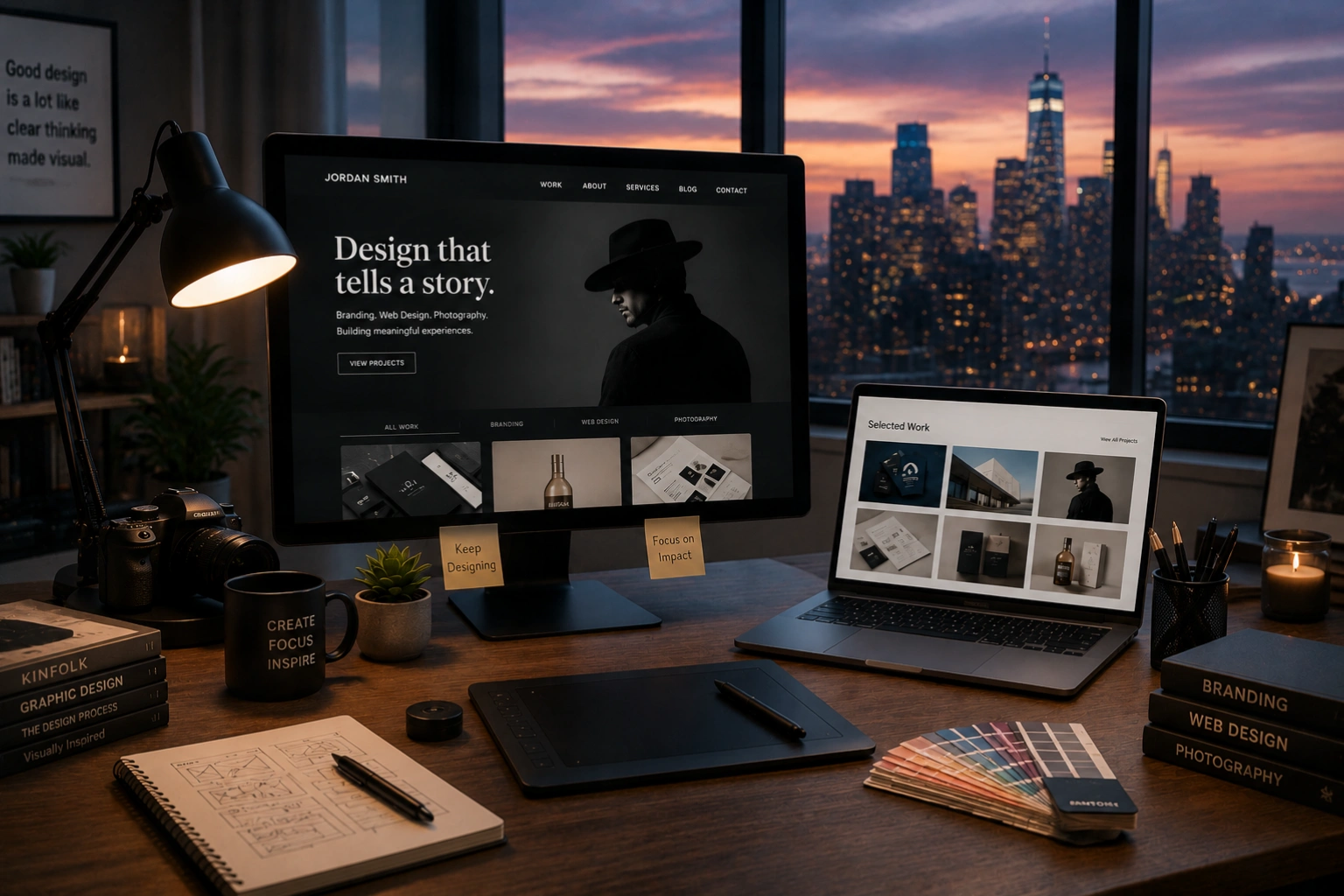
Your portfolio website is the most powerful business development tool you have as a creative professional. It works around the clock, reaches clients you have never met, and makes a case for your value before you have said a single word. Getting it right is not just a design challenge; it is a career decision.
Creative professionals face a unique challenge when building their portfolio websites: they are simultaneously the designer and the subject. The temptation is to treat the portfolio as a creative showcase, an expression of personal taste and technical range. The reality is that a portfolio website that wins clients is designed around the client's perspective, not the creative's preferences. It answers the questions a potential client is asking, not the ones the designer finds most interesting to answer.
At AG Art Studio, we have built portfolio sites for photographers, illustrators, architects, motion designers, UX designers, and brand strategists. The principles that produce results are consistent across all of them. Here is what every creative professional needs to know about designing a portfolio website that actually wins work.
The purpose of a portfolio website is not to show everything
The most common portfolio mistake creative professionals make is trying to show the full breadth of their work. The instinct is understandable; you want to demonstrate range, versatility, and the full scope of what you can do. But breadth without focus creates a confusing impression. A client looking for a brand identity designer who also finds motion graphics, illustration, web design, and photography in your portfolio does not think "this person can do everything." They think "I am not sure what this person specializes in."
The portfolios that win clients are curated, not comprehensive. They show the best work in the specific areas the creative wants to be hired for, presented in enough depth to demonstrate genuine expertise. Fifteen strong, contextual case studies in a specific discipline are more compelling than forty pieces across six different disciplines. Curation is a creative skill; applying it to your own portfolio is one of the most important decisions you will make.
Lead with your strongest work, not your most recent
The first project a visitor sees on your portfolio sets the benchmark for how they evaluate everything that follows. If your first piece is your best piece, the rest of the portfolio confirms and builds on a strong first impression. If your first piece is merely recent or representative, the strongest work later in the portfolio arrives too late to fully recover from a mediocre opening. Organize your portfolio in order of impact, not chronology. The work that best represents the clients you want to attract should always come first.
Case studies outperform image galleries
Showing the finished work is the minimum. Explaining the thinking behind it is what builds confidence. A potential client hiring a creative professional is not just buying a deliverable; they are buying a process, a perspective, and a set of problem-solving skills. A case study that walks through the brief, the challenges, the creative decisions made and why, and the outcomes achieved communicates all of those things. A gallery of beautiful images communicates only the outcome and leaves everything else to assumption.
A strong portfolio case study does not need to be long. A brief description of the client and the challenge, a clear articulation of your approach and the key decisions you made, the final work presented in context, and a note on the outcome where available is sufficient. This structure can be covered in four to six paragraphs with supporting visuals. The discipline of writing it forces clarity about your own process, which itself is a valuable exercise.
Show work in context, not just on white backgrounds
Work presented in realistic context is significantly more persuasive than the same work presented in isolation. A logo shown on a business card, a storefront, and branded merchandise tells a richer story than the same logo on a white background. A website design shown on a laptop in a real environment, or an app interface shown on a phone being held by a real person, communicates how the work functions in the real world. Mockups and lifestyle presentation are not just aesthetic choices; they help clients visualize the work in their own context, which is a critical step in the buying decision.
The portfolio that wins the most work is not the one with the most impressive work. It is the one that makes a potential client feel most clearly understood.
Your About page is a sales page
The About page is consistently among the most visited pages on any portfolio website, and it is consistently the most underinvested. Many creatives treat it as a biographical formality, a place to list where they studied and what tools they use. Clients visiting your About page are not looking for your CV; they are trying to decide whether they want to work with you. That is a fundamentally different question, and it calls for a fundamentally different response.
An effective About page for a creative professional communicates who you work with and what kinds of problems you solve, what your perspective or approach brings that is distinctive, something genuine and human about you as a person, and a clear next step. It should be written in first person, in a voice that reflects how you actually communicate, and it should end with a direct invitation to get in touch. A photo of you, ideally one that looks professional without being stiff, makes the page feel human and builds connection in a way that text alone cannot.
Make it easy to hire you
An extraordinary number of portfolio websites make contact unreasonably difficult. The contact page is buried in the footer, the email address requires copy-pasting, the inquiry form asks for a brief and a budget before the visitor has even had a conversation, or the only option is a social media link. Every piece of friction between a potential client's interest and their ability to reach you is a lead that may not convert. Your contact information should be prominent, your contact method should be simple, and your response to inquiries should be prompt.
- A direct email address that is clickable and visible on the contact page and in the site header or footer
- A contact form with no more than three or four fields; name, email, a brief description of the project, and optionally a budget range
- A clear statement of what happens next after someone submits the form; "I will respond within 48 hours" removes uncertainty and sets a professional expectation
- Links to any scheduling tool you use, such as Calendly, for clients who prefer to book a call directly rather than exchanging emails
- Your location or time zone, particularly relevant if you work internationally or have location-specific service offerings
Navigation must be minimal and purposeful
Portfolio websites frequently over-engineer their navigation. Multiple sub-sections, filtered galleries by category, separate pages for each type of work, and elaborate menu structures can make a portfolio feel comprehensive while making it genuinely harder to navigate. For most creative professionals, a portfolio site needs no more than four or five navigation items: Work, About, Services or Process, Contact, and optionally a Blog or Journal. Everything else is a distraction from the core journey you want clients to take.
The ideal user journey through a portfolio website is short and deliberate: arrive on the homepage, see your strongest work immediately, explore a case study or two, read about who you are and how you work, and contact you. Every navigation decision should either support that journey or get out of its way. If a navigation item does not move a visitor closer to contacting you, question whether it needs to exist.
Design decisions that affect portfolio performance
Speed is part of the creative impression
A portfolio website that loads slowly sends an unintentional signal about the quality of your work. For clients evaluating a creative professional, the website itself is a sample of their judgment and execution. A slow, unoptimized portfolio suggests the same carelessness that a slow, unoptimized deliverable would. Image-heavy portfolios require active performance management: every image should be compressed and served in a modern format, lazy loading should be implemented for images below the fold, and the site should score at least 75 on Google PageSpeed Insights for mobile.
The homepage must communicate your positioning immediately
A visitor who lands on your portfolio homepage and cannot immediately understand what you do, who you do it for, and what makes you worth hiring will not stay long enough to look at your work. The homepage headline is the most important piece of copy on the entire site. "Designer" tells a client almost nothing. "Brand identity design for independent hospitality businesses" tells them immediately whether they are in the right place. Specific positioning is not limiting; it is clarifying, and clarity is what converts visitors into inquiries.
Portfolio design by creative discipline
While the principles above apply broadly, different creative disciplines have specific portfolio considerations worth addressing.
Photographers- Organize galleries by genre or client type rather than showing everything together; a wedding client and a commercial client are looking for entirely different things
- Use full-bleed image presentation where possible; photography portfolios should prioritize image quality above all other design considerations
- Include a pricing page or at minimum a starting price; photography clients almost always want to know the cost before making contact, and withholding it filters out tire-kickers while losing motivated buyers
- Show behind-the-scenes content or process shots where relevant; they humanize your work and demonstrate professional capability
- Case studies are more important in UX than in any other discipline; clients are hiring your thinking process as much as your visual execution
- Include measurable outcomes where available; conversion rate improvements, task completion rates, and user satisfaction scores are far more persuasive than visual polish alone
- Clearly distinguish between work you led independently and work you contributed to as part of a larger team; honesty about your specific role builds rather than undermines trust
- Consider password-protecting work produced under NDA rather than omitting it entirely; this allows you to share it with serious prospects during the conversation stage
- Show range within your style rather than across multiple incompatible styles; clients hire you for a specific visual language, and consistency in that language is more convincing than versatility across different ones
- For motion designers, ensure video files are hosted on a fast CDN and do not auto-play at full quality on mobile; autoplay video is one of the most common performance killers on creative portfolios
- Include client names or recognizable brand logos where permission has been given; social proof through recognizable clients carries significant weight in creative industries
Before you launch: a portfolio readiness checklist
- The homepage communicates your discipline and positioning within five seconds, without scrolling
- The portfolio shows between five and twelve curated projects, each chosen to attract the clients you want next
- At least three projects are presented as case studies with context, process, and outcome, not just finished images
- All work is shown in realistic context using mockups or in-use photography rather than isolated on white backgrounds
- The About page explains who you work with, how you work, and invites contact directly
- Contact is accessible within one click from any page on the site
- The site loads in under three seconds on a mobile device
- The site displays correctly on both desktop and mobile without horizontal scrolling or overlapping elements
- A meta title and description are set for every page, with the homepage title reflecting your positioning clearly
- Google Analytics is installed so you can see which projects attract the most attention and adjust your curation over time
A portfolio website is never truly finished. The best creative professionals treat theirs as a living document, updating it as their work evolves, their positioning sharpens, and their understanding of what clients respond to deepens. The portfolio that wins the most work in 2026 is not necessarily the most technically impressive; it is the one that most clearly communicates who you are, what you do best, and why a client should choose you over everyone else who does something similar.