

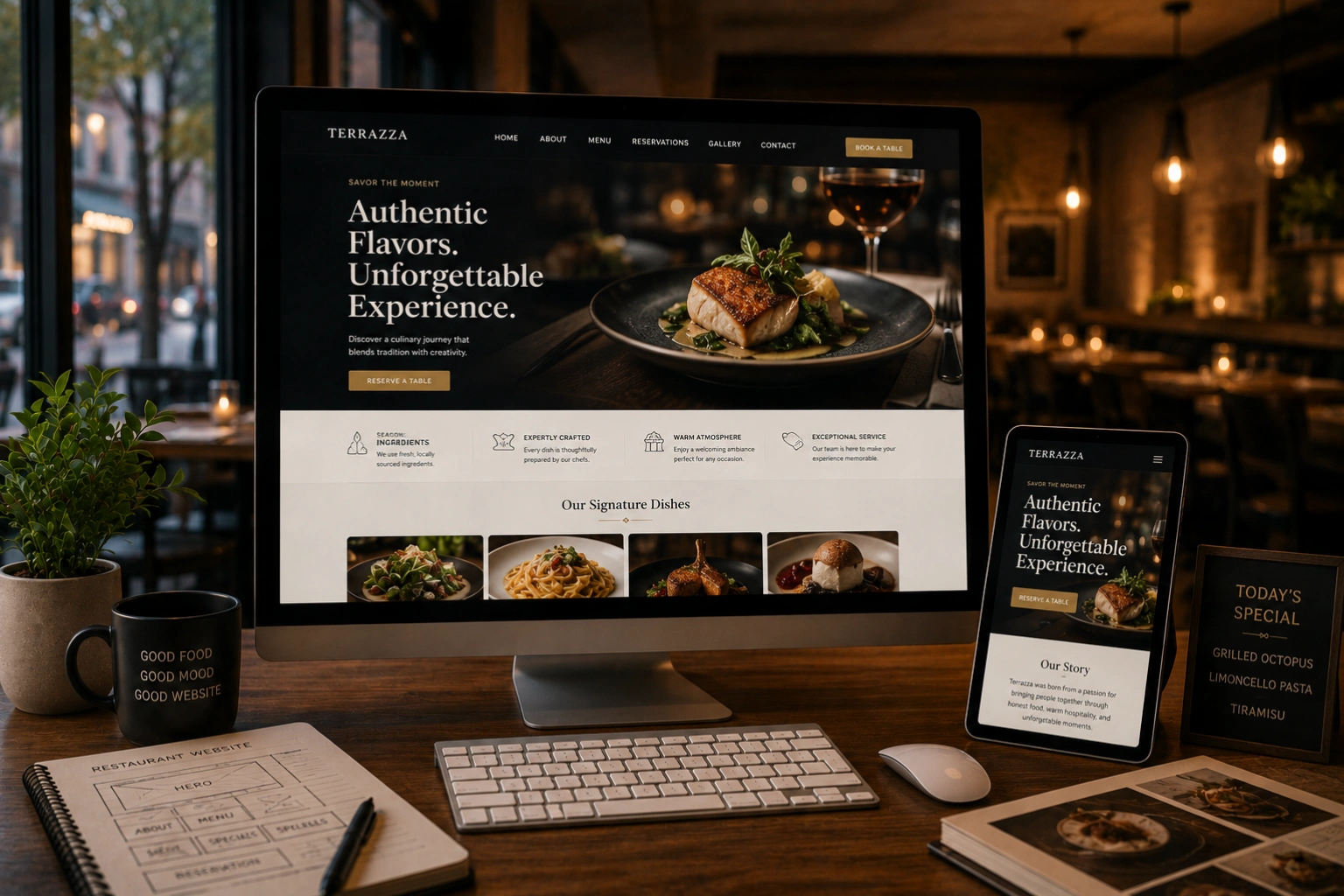
A restaurant's website is often the first table it sets for a guest. Before anyone walks through the door, they have already formed an impression based on your online presence; and in an industry where atmosphere, quality, and experience are everything, that first impression carries enormous weight. Here is how to design a restaurant website that fills seats.
The restaurant industry is one of the most visually competitive spaces on the web. Food photography, ambient design, and emotional storytelling all converge on a single digital surface that has to communicate taste, atmosphere, and trust simultaneously. Getting it right requires understanding both what restaurant guests are looking for when they visit a restaurant website and what design decisions consistently convert browsers into bookings.
At AG Art Studio, we have designed websites for restaurants, cafes, bars, and hospitality brands across a range of cuisines and price points. The patterns that determine success are clear and consistent. Here is what they look like in practice.
What guests are looking for when they visit your website
Understanding visitor intent is the starting point for effective restaurant web design. Unlike a software product or a professional service, a restaurant website serves visitors who have a very specific and predictable set of questions. Answering those questions quickly and clearly is the primary job of the design.
Research into restaurant website behavior consistently shows that the vast majority of visitors want to see the menu, find the location and hours, and make a reservation or find a contact number. These three actions account for the overwhelming majority of intent. Everything else on the website, the story, the awards, the team, the events, serves a supporting role. Design that buries these primary actions under layers of branding and storytelling is design that misunderstands its audience.
What restaurant guests look for first- The menu, including prices where possible; this is the single most visited page on most restaurant websites
- Location, hours, and parking or transport information
- Reservation booking; online booking is now strongly preferred over phone calls, particularly for younger diners
- Food photography that conveys the quality and style of the cuisine
- Contact details for private dining, events, or group bookings
Photography is the most important investment you will make
In restaurant web design, photography does not support the design; it is the design. High-quality food photography and atmospheric interior shots communicate the experience of eating at your restaurant more effectively than any copy, any color palette, or any typography choice. The difference between professional food photography and smartphone snapshots is the difference between a website that generates appetite and one that generates doubt. For restaurants operating at any price point above casual, professional photography is not optional; it is the foundation on which the entire website is built.
The photography brief for a restaurant website should cover hero-level hero shots of signature dishes; wide-angle or carefully composed interior shots that communicate atmosphere; lifestyle images of guests enjoying the space where licensing permits; and detail shots of ingredients, preparation, or plating that convey craft and quality. These images should be shot specifically for web use, optimized for fast loading without quality loss, and refreshed seasonally as the menu evolves.
The menu must be a real webpage, not a PDF
PDF menus are one of the most persistent and damaging mistakes in restaurant web design. A PDF cannot be indexed by search engines, which means every dish name, ingredient, and cuisine type on your menu is invisible to Google. PDFs are difficult to read on mobile, often requiring pinching and zooming to read. They do not load inline on most phones. And they cannot be updated dynamically when items change. A properly designed HTML menu page is faster, more accessible, more SEO-friendly, and dramatically better for the mobile experience that the majority of your visitors are having.
A well-designed menu page organizes dishes by section with clear headings, includes prices, notes allergens and dietary options clearly, and is updated regularly to reflect what is actually being served. For restaurants with seasonal menus, the menu page should be among the most actively maintained pages on the site. A menu that shows dishes that are no longer available erodes trust and creates disappointment before a guest has even arrived.
A restaurant website has one job above all others: to make someone hungry enough, and confident enough, to make a reservation. Every design decision should serve that outcome.
Online booking must be seamless and prominent
Reservation friction is reservation abandonment. A guest who arrives at your website ready to book and encounters a phone number rather than an online booking system will frequently not call; they will choose a restaurant that lets them book instantly. Online reservation tools are now expected across all but the most casual dining categories, and the booking button should be among the most prominent elements on every page of the site, not just the contact page.
The most widely used reservation platforms for restaurant websites include OpenTable, Resy, and SevenRooms at the higher end, and simpler tools like Tock or direct booking widgets for independent restaurants. Whichever system you use, the booking flow should be embedded directly on your website rather than redirecting to a third-party page; keeping guests within your branded environment throughout the booking process maintains the atmosphere and trust you have worked to establish.
Design must communicate the experience, not just describe it
Restaurant websites that rely on adjectives, "intimate," "vibrant," "authentic," "seasonal," fail to do what design can do so much more effectively: show rather than tell. The color palette, typography, imagery, spacing, and overall aesthetic of the website should evoke the feeling of being in the restaurant before the guest has visited. A fine dining establishment should feel refined and considered. A casual neighborhood bistro should feel warm and approachable. A modern Asian fusion restaurant should feel contemporary and precise. The design is the atmosphere, translated to screen.
This alignment between physical and digital experience requires deliberate design decisions at every level. The font choice should reflect the restaurant's personality; a hand-drawn script for a rustic trattoria, a clean geometric sans for a minimalist Japanese restaurant. The color palette should evoke the mood of the dining room. The image selection and cropping should reflect the light and atmosphere of the space. When design and dining room are genuinely aligned, the website functions as a reservation-generating extension of the guest experience rather than a generic placeholder between the guest and the door.
Location and hours must be impossible to miss
A remarkable proportion of restaurant websites make guests work to find the address and opening hours. These are the two pieces of information most likely to determine whether a visit actually happens, and they should be available on every page of the site, either in the header, the footer, or both. The address should link directly to Google Maps. Hours should reflect any seasonal or holiday variations and be updated proactively. A guest who arrives at a closed restaurant because the website showed outdated hours is a guest who will not return and who may leave a negative review.
Mobile performance is non-negotiable
More than 60% of restaurant-related searches happen on mobile devices, often at the moment of decision; a group of friends deciding where to eat, a couple looking for somewhere to mark an occasion, a solo diner wanting to book for the following week. The mobile experience of your restaurant website is not a secondary consideration; it is the primary one. Every element of the design, from the navigation to the menu layout to the booking flow, should be tested and optimized specifically for a 375-pixel screen before being adapted for desktop.
Common mobile failures on restaurant websites include PDF menus that require pinching to read, reservation buttons that are too small to tap reliably, image galleries that load slowly on cellular connections, and maps that are impossible to interact with on a touchscreen. Each of these failures occurs at the moment of highest intent, when a guest has already decided they are interested and is simply trying to complete the booking. Losing them at this point is among the most expensive design failures a restaurant can make.
Reviews and social proof belong on the website
Third-party review platforms like Google, TripAdvisor, and Yelp carry significant trust weight, but waiting for guests to find your reviews elsewhere is a missed opportunity. Embedding your Google review rating on your website, featuring selected guest testimonials in a dedicated section, and displaying press mentions or awards where relevant brings that social proof into the guest journey at the moment it is most persuasive; when they are actively evaluating whether to visit. A strong aggregate rating displayed prominently on the homepage is one of the fastest trust-builders available to any restaurant.
Common restaurant website mistakes to avoid
- Autoplay music or video with sound; nothing drives visitors away faster than unexpected audio, particularly on mobile in a public setting
- PDF menus; replace with a properly designed HTML menu page that is readable on mobile, indexable by search engines, and easy to update
- Outdated information; hours, menus, and special events must be current; outdated content erodes trust and generates negative experiences before the guest has even arrived
- No online booking; in 2026, the absence of online reservation capability is a competitive disadvantage across all but the most deliberately reservation-free concepts
- Stock photography of food; guests are sophisticated enough to recognize generic food photography; invest in real images of your actual dishes
- Slow load times; a restaurant website heavy with unoptimized photography will load slowly and lose the mobile guests who are deciding in the moment
- Navigation that buries the menu; the menu page should be one click from anywhere on the site; it is the most visited page and should be treated accordingly
- No Google Business Profile integration; your website and Google Business Profile should be consistent in address, hours, and photography, and should link to each other
SEO for restaurant websites
Local SEO is among the highest-return digital marketing investments available to a restaurant. When someone searches for "Italian restaurant in [city]" or "best brunch near me," appearing in the top results and in the Google Map Pack directly drives covers. The design and structure of your website plays a central role in how well you rank for these searches.
Your Google Business Profile is as important as your website
For local restaurant searches, the Google Business Profile often appears before the website in search results. It should be fully completed with accurate address, hours, phone number, and booking link; populated with high-quality photos updated regularly; and actively monitored for new reviews that deserve a response. The consistency between information on your website and your Google Business Profile is a local SEO signal; discrepancies between the two confuse both Google and potential guests.
Structured data helps Google understand your restaurant
Adding Restaurant schema markup to your website in JSON-LD format tells Google explicitly what type of business you are, your cuisine type, your price range, your hours, and your location. This structured data can enhance how your site appears in search results, potentially including rich snippets with your rating and price range directly in the result. It is a technical addition that takes less than an hour to implement and pays ongoing dividends in search visibility.
- Google Business Profile is fully completed, verified, and updated with current photos and hours
- Name, address, and phone number are identical on the website, Google Business Profile, and all directory listings
- Restaurant schema markup is implemented on the homepage with cuisine type, price range, and hours
- The website title tag and homepage H1 include the restaurant name and location or cuisine type
- A dedicated page exists for private dining, events, or catering if these are offered, with their own targeted copy
- The website is connected to Google Search Console and any mobile usability issues are resolved
- Page load speed on mobile is under three seconds; restaurant searches happen in the moment and patience is limited
A restaurant website launch checklist
- Professional food photography covers all signature dishes and the dining environment
- The menu is a live HTML page, organized by section, with prices and allergen information
- Online booking is embedded directly on the site with a prominent button in the header
- Address and hours are displayed in the footer on every page and link to Google Maps
- The site loads in under three seconds on a mobile device with images optimized for web
- Google review rating or selected testimonials are displayed on the homepage
- The design communicates the atmosphere and positioning of the restaurant through typography, color, and imagery
- Restaurant schema markup is implemented and verified in Google's Rich Results Test
- Google Business Profile is verified, fully completed, and linked to the website
- Google Analytics and Search Console are both installed and confirmed working
- All pages have unique meta titles and descriptions that include the restaurant name and relevant keywords
- The site has been tested on both iOS and Android across multiple screen sizes
A restaurant website is not a static marketing brochure; it is a dynamic, living extension of the dining experience. The restaurants that maintain a strong online presence, with current menus, regular photo updates, active review management, and a booking experience that matches the quality of their service, consistently outperform those that treat their website as a one-time project. In an industry where reputation is everything and first impressions are formed before a guest walks through the door, the website is where that reputation begins.