

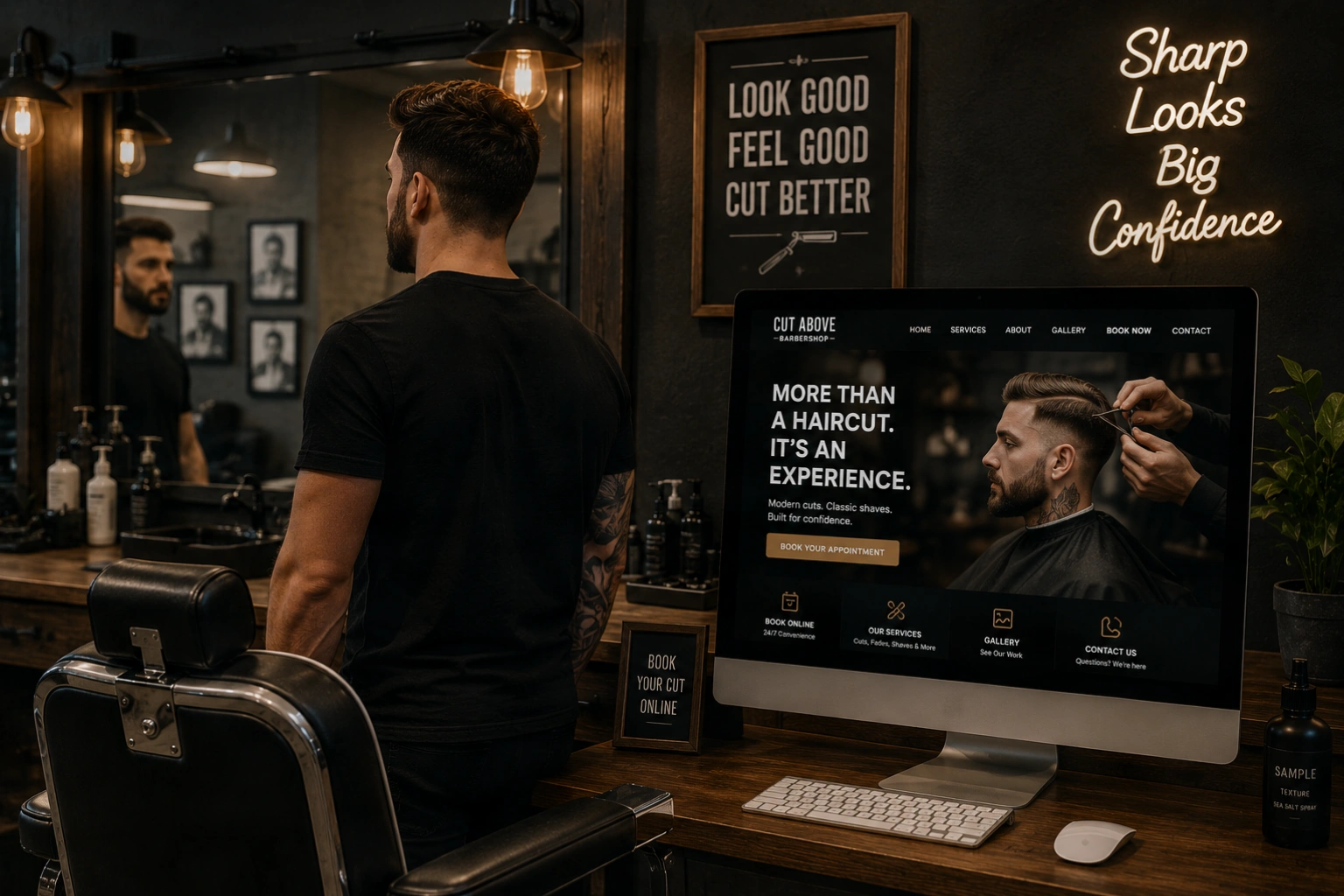
Most barbershop websites are an afterthought. A logo, a phone number, maybe a list of services with prices, and a Google Maps embed that half the time does not load correctly on mobile. It is the digital equivalent of a sandwich board leaning against the door. In a market where clients choose their barber based on trust, style, and the feeling a shop gives them before they ever walk in, a weak website is not just a missed opportunity. It is actively costing you bookings every single week.
The barbershop industry is more competitive than it has ever been. New shops open constantly, franchise chains are expanding into local markets, and clients have more options than ever. The barbershops that are consistently fully booked are not necessarily the ones with the best barbers. They are the ones whose entire client-facing presence, from Instagram to Google to their website, works together to build confidence, communicate their identity, and make booking as easy as possible.
At AG Art Studio, we have built websites for independent service businesses across the country. Here is exactly what a barbershop website needs to do, and what most of them get badly wrong.
What a barbershop website actually needs to do
Win the local search moment before anything else
When someone searches "barber near me" or "best barbershop in [city]", the businesses that appear at the top of the results and in the map pack get the vast majority of clicks. Your website is the foundation of that local visibility. It needs to clearly signal your location, the services you offer, and the areas you serve through properly structured page content, title tags, and schema markup. A website that does not mention your city, neighbourhood, or nearby landmarks in its content is effectively invisible to the local search queries that drive walk-in and new client traffic. This is not complicated to fix, but it is almost universally neglected on barbershop websites built without professional SEO input.

Make booking frictionless, fast, and available 24/7
The single highest-impact feature any barbershop website can have is a properly integrated online booking system. Not a contact form. Not a "call us to book" button. An actual booking tool where a visitor can select their barber, choose their service, pick a time, and confirm the appointment in under two minutes without speaking to anyone. Clients book haircuts while lying in bed, on their lunch break, or after your shop has closed for the night. Every minute of friction in that process, and every moment where they are asked to call instead of click, is a booking you lose to the competitor down the street whose website lets them book instantly. Tools like Fresha, Booksy, and Square Appointments integrate cleanly into a properly built website and pay for themselves many times over in recovered bookings alone.
Show the work prominently and let it speak first
A barbershop is a visual service. The primary thing a new potential client wants to see before they book is the quality and style of your cuts. This seems obvious, but the majority of barbershop websites either have no gallery at all, feature a few low-quality phone photos buried at the bottom of the page, or use generic stock images of scissors and combs that tell a visitor nothing about what they will actually get. Your work gallery needs to be prominent, high-quality, updated regularly, and organised by style where possible so that clients who want a skin fade can see examples of your skin fades rather than having to scroll through beard trims to find them. A well-presented portfolio of real work is the most persuasive thing on a barbershop website and the element most shops underinvest in.


Introduce your barbers as people, not job titles
Clients do not book a barbershop. They book a barber. The relationship between a client and their regular barber is one of the most personal in any service industry, and the website should reflect that. A team page that shows each barber's face, name, specialities, and personality does more to drive first-time bookings than almost any other page element. When a new visitor can look at your team and think "that's the person I want cutting my hair", they book with confidence rather than anxiety. A list of first names next to a phone number does not achieve this. Real photos, real bios, and real personality do. If your barbers are active on Instagram, linking their profiles from the team page adds another layer of social proof that costs nothing to implement.
Design for mobile first, because that is how clients find you
The overwhelming majority of barbershop website visits happen on mobile, typically within a search session where someone is actively looking for a place to book. A website that is hard to navigate on a phone, has buttons that are too small to tap accurately, loads slowly on a mobile connection, or requires pinching and zooming to read the service menu is a website that sends potential clients elsewhere. Mobile-first design is not simply about making the desktop site smaller. It means designing the entire experience around the thumb, the small screen, and the expectation of speed that mobile users have. The booking button needs to be immediately visible without scrolling. The phone number needs to be a tap-to-call link. The service menu needs to be readable at arm's length.

Display reviews where they have the most impact
Social proof is the most powerful conversion tool available to a local service business, and most barbershop websites fail to use it at all. Reviews from Google, Yelp, or Facebook should appear on your website, not just on the platforms they were originally left on. The best placement is near the booking call to action, where a visitor is on the edge of committing and a few lines from happy clients can be the thing that pushes them to confirm. Displaying a live feed of your Google reviews, or manually featuring five or six strong quotes from real clients with their names and the service they had, builds the trust that converts a browsing visitor into a booked appointment. A generic testimonials section at the bottom of a page that nobody scrolls to achieves almost nothing.
Connect your Instagram feed so the site stays fresh automatically
Most barbershops post to Instagram regularly but never update their website. The result is a website that looks static and dated while the Instagram feed is lively and current. Connecting an Instagram feed to your website solves both problems simultaneously: the site stays visually fresh without anyone needing to log in and update it, and visitors who see work they like can follow your account directly from the website, deepening the relationship before they ever visit the shop. An embedded Instagram feed in the gallery section or the homepage makes the site feel alive in a way that a static photo grid never can, and it is one of the lower-effort, higher-impact implementations a barbershop website can have.


A barbershop website is not a digital business card. It is a booking machine, a portfolio, and a trust-builder working together around the clock. Every element should serve one of those three functions or it should not be there.
Barbershop website elements compared by booking impact
| Element | Booking impact | Most shops have it? | Priority |
|---|---|---|---|
| Online booking integration | Very high | Rarely done well | Highest |
| High-quality work gallery | Very high | Rarely done well | Highest |
| Local SEO foundations | High | Almost never | Highest |
| Mobile-first design | High | Sometimes | High |
| Team page with real photos | Medium-high | Rarely | High |
| Reviews displayed on site | Medium-high | Almost never | Medium |
| Instagram feed integration | Medium | Rarely | Medium |
| Services and pricing page | Medium | Most have one | Medium |
The mistakes most barbershop websites make

What to prioritise when building or redesigning your barbershop site
- Online booking is integrated directly into the site and works smoothly on mobile, allowing clients to book a specific barber and service in under two minutes
- The homepage makes the shop name, location, and a booking call to action visible without scrolling on a mobile screen
- Opening hours are displayed prominently and consistently across the site, and match what is shown on Google Business Profile
- The work gallery features real, high-quality photos of cuts done at the shop, updated at least monthly, and organised by style where possible
- Each barber has a profile page or section with a real photo, their name, their specialities, and ideally a link to their Instagram
- The services and pricing page is clear, complete, and formatted so it is easy to read on a mobile screen
- The site mentions the city, neighbourhood, and nearby landmarks in its page content to support local search visibility
- Real client reviews are displayed near the booking call to action, not buried at the bottom of a page nobody scrolls to
- The phone number is a tap-to-call link on mobile and appears in the header on every page
- The site loads in under three seconds on a mobile connection, tested using Google PageSpeed Insights
- The Instagram feed is connected and displaying recent posts, keeping the site visually current without manual updates
- The Google Business Profile is fully completed, linked to the website, and has been verified with a consistent NAP (name, address, phone) across all platforms
A barbershop that is serious about growth cannot afford to treat its website as a secondary concern. The chair fills up one of two ways: word of mouth from existing clients, or discovery by new ones who find you online. A well-built website does not replace the craft or the relationships that make clients loyal. It makes sure that the craft and the relationships you have already built are visible, credible, and accessible to every potential client who searches for a barber in your area. That is a straightforward commercial investment with a measurable return, and it is one of the highest-leverage things an independent barbershop can make.
Yes, for several reasons. Instagram gives you no control over your booking flow, no local search visibility, and no protection against platform changes that could affect your reach overnight. A website is the only part of your online presence you fully own and control. It is also where Google sends people who search for barbers in your area: a strong Instagram following does not appear in Google search results, but a well-optimised website does. The two work best together: Instagram builds your audience and showcases your work, while the website captures the local search traffic and converts it into bookings through a system you control.
Fresha is the most widely used in the barbershop industry and is free to use with no monthly subscription, taking a small commission only on new clients acquired through the Fresha marketplace. Booksy is popular for shops with multiple barbers and has strong marketing features. Square Appointments integrates well if you already use Square for payments. The best platform is the one your barbers will actually use consistently, since an abandoned booking system that shows no availability is worse than having none at all. Most platforms offer a free trial and embed cleanly into a properly built website.
The work gallery should be updated at minimum monthly, and ideally weekly with new examples of cuts. Opening hours, pricing, and team information should be updated immediately whenever anything changes, since outdated information is one of the most common reasons potential clients lose trust in a local business. If your website is connected to your Instagram feed, the visual content updates automatically. Beyond that, seasonal promotions, new service additions, and any changes to the team are all worth updating promptly. Google rewards websites that show regular signs of activity, and clients who visit the site multiple times notice when it has not changed.
Very. Potential clients who cannot find your prices on your website will frequently assume you are more expensive than you are, or simply choose a competitor whose pricing is transparent. Displaying your service menu with clear pricing removes a barrier to booking and builds trust by demonstrating you have nothing to hide. If your prices vary by barber or by experience level, explain that clearly rather than leaving it ambiguous. The only situation where not showing prices makes strategic sense is if you are a premium shop intentionally positioning above the market, where price transparency might undermine a premium positioning. For the majority of independent barbershops, clear pricing is always the right call.
A properly built barbershop website from a professional agency, with custom design, booking integration, local SEO foundations, a work gallery, team profiles, and mobile-first build, typically costs between $3,000 and $8,000 depending on complexity and the agency involved. DIY options like Wix or Squarespace can produce something functional for a few hundred dollars, but they impose real limits on SEO performance, booking integration flexibility, and design distinctiveness. Given that a single additional regular client is worth $500 to $1,000 or more per year, a properly built website pays for itself with a handful of new bookings and continues returning value for years. The ongoing cost of hosting and maintenance should be budgeted at $80 to $150 per month.
The platform matters less than the quality of the design, the strength of the booking integration, and the SEO foundations. WordPress, Webflow, Squarespace, and Wix can all produce effective barbershop websites in the right hands. The more important questions are whether the person building it understands local SEO, whether they have experience integrating booking systems cleanly, and whether the result will be genuinely distinctive rather than a generic template that looks like every other local service business site. A great barbershop website on Squarespace will outperform a poor barbershop website on WordPress every time. Focus on the output quality and the expertise of whoever is building it rather than the platform choice.