

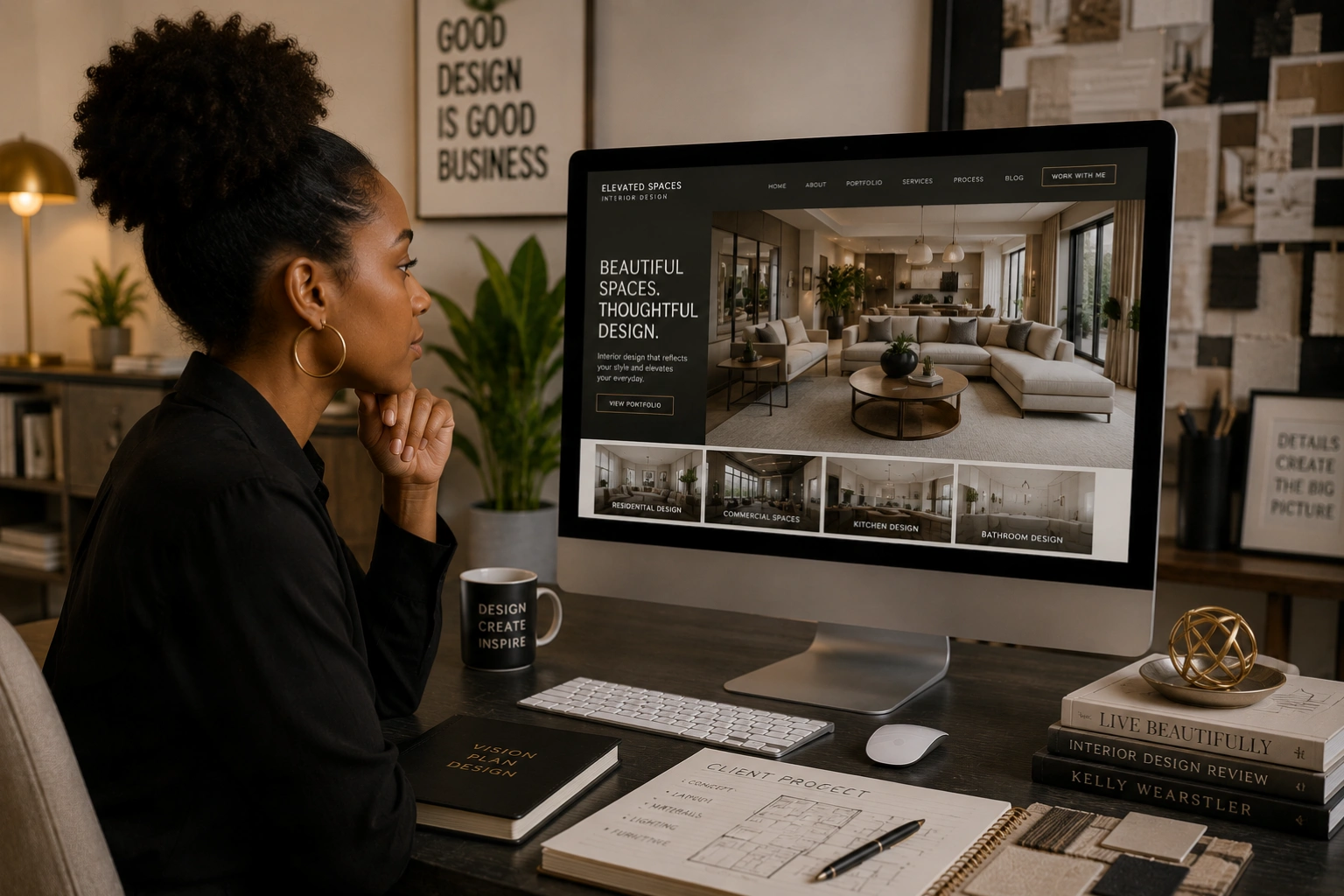
An interior designer's website is not simply a marketing tool. It is the first room a prospective client walks into. Before they call, before they email, before they commit a single dollar to a project, they are forming a judgment about your taste, your professionalism, and your ability to transform a space, entirely from what they see on their screen. A website that does not reflect the quality of your work, communicate your process with clarity, and make the first step toward hiring you feel obvious and easy is a website that is losing you clients every single week, silently and without any visible evidence of the cost.
Interior design is one of the most visually demanding industries on the web. Your potential clients are people who care deeply about aesthetics. They notice everything: the typography, the whitespace, the quality of the photography, the way the portfolio is laid out. A site that looks generic, loads slowly, or presents beautiful work in an ugly frame sends a signal that contradicts everything you are trying to sell. The good news is that when an interior designer's website is done well, it does an extraordinary amount of selling on its own, working around the clock to build desire, establish trust, and filter for the kind of clients who are a genuine fit for your practice.
At AG Art Studio, we build websites for creative professionals who understand that presentation is part of the product. Here is the complete framework for what an interior designer's website needs to do, and how to make sure yours is doing it.
What an interior designer's website needs to do
Lead with a portfolio that does the selling before you speak
The portfolio is the centrepiece of every interior designer's website, and the quality with which it is presented determines whether a visitor feels desire or indifference. This means full-width, high-resolution photography shot by a professional architectural photographer, not phone snapshots taken on completion day. It means projects presented as complete narratives with a brief, the challenge, the solution, and multiple images showing the space from different angles and in different light conditions, not a grid of single images with no context. It means the portfolio is organised by project type, aesthetic, or room category so that a visitor searching for a specific style or space can find the most relevant examples immediately. The portfolio is not a gallery. It is your primary sales document, and it should be designed and curated with that level of seriousness.

Make your process visible, specific, and reassuring
One of the biggest barriers to enquiry for high-value service businesses is not price, it is uncertainty. Potential clients who do not know what working with you looks like, how long it takes, what decisions they will need to make, and what they are responsible for, hesitate to reach out because the unknown feels risky. A clearly presented process page that walks through each stage of an engagement, from initial consultation through concept development, sourcing, installation, and final reveal, removes that uncertainty and replaces it with confidence. The best process pages use a combination of a visual timeline or numbered steps with a paragraph of explanation for each stage, real photography from each phase where possible, and a clear indication of what the client's involvement looks like at each point. This page alone can be the difference between an enquiry and a bounce from a qualified prospect.
Build a designer profile that creates genuine connection
Interior design is a deeply personal service. Clients invite you into their homes and trust you with significant financial decisions and deeply held preferences about how they want to live. They do not hire a business. They hire a person. Your About page needs to reflect this. A paragraph of professional credentials and a headshot taken at arm's length is not enough. An About page that communicates your design philosophy, what draws you to the work, the kinds of spaces and clients you love working with, and the aesthetic principles that guide your decisions builds the kind of personal connection that makes a prospect feel they have already found the right person before they have spoken to you. Clients who feel that connection enquire with enthusiasm and convert at far higher rates than those who arrive cold with no sense of who they are hiring.


Let clients speak for you with strategically placed testimonials
For a service with average project values in the thousands of dollars, trust is the primary purchase barrier. No amount of beautiful portfolio photography closes the gap that a genuine client testimonial can close. The key is placement and specificity. Testimonials buried in a dedicated page nobody navigates to are largely wasted. Testimonials placed on the homepage near the enquiry call to action, alongside relevant project images, and on the process page where a visitor is evaluating whether to take the next step, work significantly harder. The most effective testimonials are specific: they describe the client's situation before the project, what the experience of working with you was like, and the outcome in concrete terms. A quote that says "absolutely loved working with her, would highly recommend" does far less work than one that describes a specific transformation and the emotional response to the finished space.
Optimise for the searches your ideal clients actually use
Most interior designer websites are effectively invisible to search engines because they contain almost no text. A portfolio site built entirely from images with minimal written content gives Google nothing to index and rank. The fix is not to fill the site with keyword-stuffed paragraphs that undermine the visual experience. It is to add well-written, keyword-informed descriptive text to project pages, to write a services page that addresses the specific terms potential clients search for, and to ensure that location-based keywords appear naturally throughout the site for designers working in a specific geography. An interior designer in Austin should rank when someone searches "interior designer Austin" or "luxury home interior design Austin." That requires both the right content and the right technical setup, and neither happens by accident on a portfolio-first site built without SEO input.

Design an enquiry experience that qualifies and converts simultaneously
The enquiry form on most interior designer websites is a standard three-field contact form that collects a name, an email, and a blank message box. This creates two problems: it gives you no useful information about the prospect before you respond, and it gives the prospect no guidance about what to include, resulting in vague messages that require multiple back-and-forth exchanges to establish basic project viability. A well-designed enquiry form asks the questions that determine fit: project type, approximate budget range, timeline, location, and how they heard about you. It sets expectations about your response time and what the next step looks like. It screens out prospects who are not a fit for your practice before either party invests time in a conversation that was never going to go anywhere. For high-value service businesses, a better enquiry form is one of the highest-leverage improvements a website can make.
Ensure the visual experience holds up on every screen
A portfolio-heavy website that looks spectacular on a 27-inch desktop monitor but breaks down on a phone is a significant commercial problem, because a large proportion of initial discovery happens on mobile. When a potential client is referred to you by a friend, the first thing they do is search your name on their phone. When they see your work featured on Instagram or Pinterest and click through to your site, they are on a mobile device. The mobile experience needs to present your photography at its best within the constraints of a small screen: full-width images that fill the viewport, smooth swiping through project galleries, text that is readable without zooming, and a contact button that is immediately accessible without scrolling. A designer whose work is beautiful but whose mobile site is broken is losing referral traffic at the exact moment of highest intent.


An interior designer's website is not a portfolio archive. It is the first space you design for a prospective client. Every visual decision, every word, and every interaction tells them something about what it will feel like to work with you.
Key website elements compared by client conversion impact
| Element | Conversion impact | Most designers have it? | Priority |
|---|---|---|---|
| Professional project photography | Very high | Rarely at full quality | Highest |
| Narrative project case studies | Very high | Almost never | Highest |
| Clear process page | High | Rarely | Highest |
| Personal, specific About page | High | Sometimes | High |
| Strategically placed testimonials | Medium-high | Rarely placed well | High |
| Qualifying enquiry form | Medium-high | Almost never | Medium |
| Location-based SEO content | Medium | Almost never | Medium |
| Mobile-optimised gallery | Medium | Sometimes | Medium |
The most common mistakes on interior designer websites

Building a website that attracts the right clients, not just any clients
- Every portfolio project is shot by a professional architectural photographer and presented at full resolution
- Each project page includes a written brief, the design challenge, the solution, and multiple images showing the space comprehensively
- The portfolio is organised so visitors can filter or navigate to the project types and aesthetics most relevant to them
- A process page explains each stage of an engagement clearly, including what the client's involvement looks like at each step
- The About page communicates your design philosophy, the clients you love working with, and what makes your approach distinct
- Client testimonials are placed near calls to action throughout the site, not only on a dedicated testimonials page
- The enquiry form asks qualifying questions about project type, budget range, timeline, and location
- The site includes written content on project pages and a services page that targets the search queries your ideal clients use
- Location-based keywords appear naturally in the content for designers serving a specific geographic market
- The mobile experience presents project photography at its best, with smooth gallery navigation and an immediately accessible contact option
- The visual design of the website is consistent with and reflective of the aesthetic the designer brings to client projects
- The site loads in under three seconds and passes Core Web Vitals, since large image files are the primary performance risk on portfolio sites
An interior designer's website is one of the few business investments that pays back in both commercial results and personal satisfaction. When it reflects your actual aesthetic, presents your best work with the care it deserves, and communicates who you are and how you work with honesty and specificity, it stops feeling like a marketing tool and starts feeling like an extension of your practice. The clients it attracts arrive already aligned with your vision, already confident in your ability, and already prepared to invest at the level your work is worth. That quality of client relationship is worth far more than any number of enquiries from visitors who found a generic portfolio and are simply shopping on price.
This is one of the most debated questions in interior design marketing, and the right answer depends on your positioning. Designers working in the mid-market benefit from showing at least a starting-from figure or project minimums, because it pre-qualifies visitors and prevents time lost on consultations with prospects who cannot afford the engagement. Designers positioning at the premium or luxury end often prefer not to show prices, instead filtering through an enquiry process that establishes fit before investment is discussed. What almost never works is showing no price information and no indication of project minimums, which leaves all visitors uncertain and self-qualifying as unable to afford you regardless of their actual budget.
Quality always outperforms quantity in an interior design portfolio. Six to twelve beautifully photographed, fully documented projects that represent your best work and the direction you want your practice to go will outperform thirty projects of mixed quality every time. Visitors do not scroll through every portfolio item. They scan the first several, form an impression, and either decide to enquire or leave. That impression is set by the best and worst projects they see, so removing weaker work and investing in professional photography for your strongest projects is nearly always a better use of resources than adding more content. As your portfolio grows, be willing to retire older projects that no longer represent your current standard or aesthetic direction.
A blog is valuable if you will publish consistently and write content that is genuinely useful or interesting to your target client, not just to other designers. Blog content that addresses the questions your ideal clients have before they hire an interior designer, covering topics such as how to brief a designer, what to expect during a renovation, how to select materials, or how to think about budget allocation, can attract organic search traffic and build trust with prospects over time. A blog that is updated once and then abandoned for two years does more harm than good, as it signals to visitors and to Google that the business is not active. Only commit to a blog if you have a realistic content plan and the discipline to maintain it.
Squarespace and Webflow are both well-suited to interior design websites because they handle large image portfolios cleanly, offer strong visual design tools, and produce good performance with minimal technical management. WordPress with a well-chosen theme and proper hosting is a strong option for designers who want maximum flexibility and SEO control. Platforms like Format and Cargo are portfolio-specific tools that make setup fast but offer limited flexibility for growing a content-rich site. The most important factor is not the platform but the quality of the design and the quality of the images being displayed. A beautifully photographed project on a simple Squarespace layout will outperform an average portfolio on a technically sophisticated custom build every time.
Instagram and Pinterest are powerful discovery channels for interior designers and can drive significant referral traffic to your website. However, they are not substitutes for a strong website for several reasons. Social platforms control your reach and can change their algorithms at any time. They do not rank in Google for the search queries that indicate buying intent. They offer no ability to qualify prospects, communicate your process, or capture enquiries in a structured way. The most effective client acquisition system uses Instagram and Pinterest as awareness drivers that funnel interested visitors to a website that converts that interest into a qualified enquiry. Each platform plays a distinct role, and investing in one at the expense of the other creates a gap in the client acquisition journey.
A professionally designed interior design website with custom design, portfolio architecture, project case study pages, a process page, an About page, a qualifying enquiry form, and basic SEO foundations typically costs between $4,000 and $12,000 depending on the agency and the number of projects documented at launch. Professional architectural photography, if not already commissioned, should be budgeted separately at $800 to $2,500 per project depending on the photographer and location. Given that a single interior design project can be worth $20,000 to $100,000 or more, a website investment that generates even one additional qualified client per year represents an extraordinary return. The businesses that treat their website as a cost to minimise rather than an asset to invest in consistently underperform relative to their actual talent and work quality.