

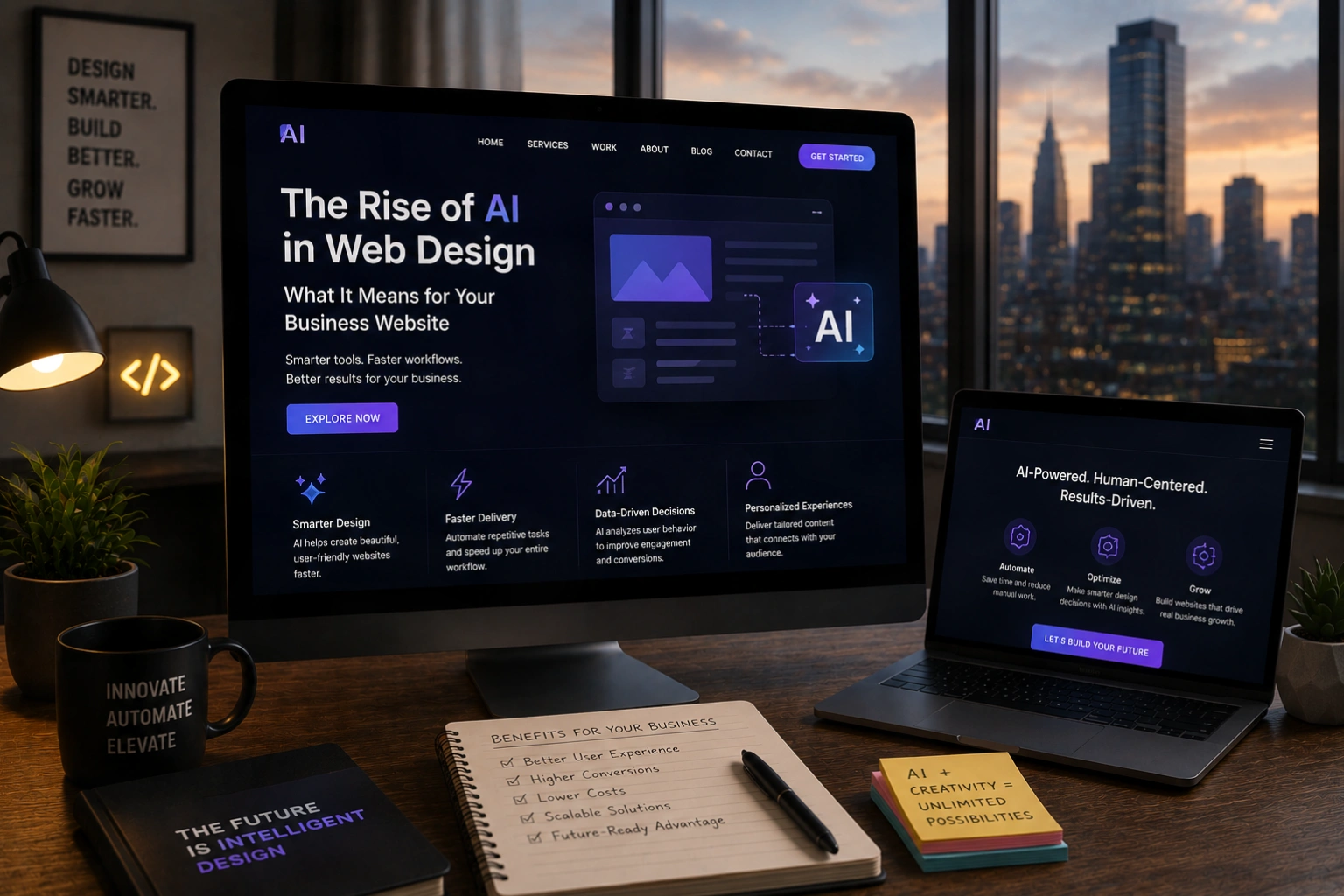
Artificial intelligence is reshaping web design faster than any technology shift in the last decade. For business owners, the question is no longer whether AI will affect your website; it already has. The question is whether you understand what it can genuinely do, what it cannot, and how to use it as a competitive advantage rather than a shortcut to mediocrity.
Every week brings a new AI tool claiming to design, write, or build websites autonomously. Some of these claims are meaningful. Many are not. The businesses that navigate this landscape well are the ones that separate the genuine capability from the hype, understand where AI creates real value in the design process, and recognize what it still cannot replace. The businesses that get it wrong either ignore AI entirely and fall behind, or lean on it uncritically and end up with websites that look and feel like everything else.
At AG Art Studio, we use AI tools as part of our design and development workflow every day. Here is an honest, practical account of where AI is genuinely transforming web design in 2026 and what it means for your business website.
The reality vs. the hype: what AI can and cannot do
The AI web design conversation is shaped more by marketing than by honest capability assessment. Understanding the real picture requires separating what AI tools genuinely do well from the claims that outpace the actual technology.
- "AI can design your entire website in minutes"
- "AI-generated sites are indistinguishable from custom design"
- "AI replaces the need for a web designer entirely"
- "AI understands your brand and business goals automatically"
- "AI-written content ranks as well as expert-written content"
- "AI tools eliminate the need for strategy or creative direction"
- AI accelerates specific parts of the design process significantly
- AI-generated layouts require expert curation and refinement to be distinctive
- AI is a powerful tool for skilled designers, not a replacement
- AI needs detailed human input to reflect genuine brand strategy
- AI content needs expert editing and fact-checking before publishing
- Strategy, positioning, and creative direction remain human responsibilities
Where AI is genuinely transforming web design
Layout generation and design exploration
AI tools can now generate functional website layouts from a brief text description in seconds. Tools like Framer AI, Relume, and various Figma plugins allow designers to generate multiple structural options rapidly, which dramatically accelerates the early exploration phase of a project. What would previously take a designer several hours to produce manually can now be generated, evaluated, and iterated in a fraction of the time. The output still requires expert judgment to select, refine, and elevate into something distinctive; but the speed advantage in the early stages is genuine and significant.
AI-assisted copywriting
AI writing tools have become a standard part of the web design workflow for generating first drafts, headline variations, meta descriptions, and button copy. They excel at producing structured, grammatically correct text quickly, which reduces the time from brief to draft considerably. The limitations are equally real: AI-generated copy tends toward the generic, lacks genuine brand voice, and cannot draw on the specific insights that come from knowing a business deeply. The most effective use is AI as a starting point for a skilled writer, not as a replacement for one. Published AI copy that has not been significantly edited and refined is detectable, often feels flat, and can undermine the credibility it is supposed to build.
AI image generation for web design
AI image generation tools have reached a level of quality that makes them genuinely useful for concept illustration, background textures, abstract visuals, and decorative imagery. For businesses that previously relied on generic stock photography, AI-generated imagery can provide a more distinctive visual layer at a fraction of the cost of commissioned photography. The important caveat is that AI image generation is not a substitute for professional photography of real people, real products, or real environments; the authenticity gap is still significant enough that most users recognize and discount AI-generated faces and scenes in high-stakes contexts like product pages, about pages, and testimonials.
AI does not replace creative judgment; it amplifies it. In the hands of a skilled designer, AI tools produce better work faster. In the hands of no designer at all, they produce fast mediocrity.
AI-assisted development and code generation
For developers, AI coding assistants have become among the most impactful productivity tools available. Tools like GitHub Copilot and Claude can generate functional code from natural language descriptions, explain unfamiliar code, suggest optimizations, and debug errors. In web development specifically, this acceleration is felt most in the repetitive implementation work that has historically consumed significant developer time: building out component variations, writing responsive CSS, generating form validation logic, and setting up CMS templates. The developer still architects, reviews, and is responsible for the final output; but the time to reach that output is measurably shorter.
AI-powered personalization
One of the most commercially significant applications of AI in web design is real-time personalization: the ability of a website to adapt its content, recommendations, and calls to action based on individual visitor behavior, location, referral source, and browsing history. This capability, once available only to enterprise platforms with significant engineering investment, is now accessible through off-the-shelf tools and integrations at price points that small and medium businesses can justify. Visitors who experience personalized content convert at measurably higher rates than those who encounter a generic experience, and the gap is expected to widen as personalization tools become more sophisticated.
AI-driven testing and conversion optimization
Traditional A/B testing requires significant traffic volumes to reach statistical significance and weeks or months to produce actionable conclusions. AI-powered testing platforms can analyze user behavior, identify patterns, and surface optimization opportunities from smaller data sets and in shorter timeframes. Tools like Mutiny, Intellimize, and various built-in features in marketing platforms now offer AI-driven multivariate testing that adapts in real time rather than waiting for a fixed test to conclude. For businesses with meaningful traffic volumes, this represents a genuine step change in the pace of conversion optimization.
What AI genuinely cannot replace in web design
For all the genuine capability above, there are dimensions of web design that AI tools are structurally unable to provide, and that remain the core value of working with skilled human designers and strategists.
Strategic thinking is perhaps the most important of these gaps. AI can generate a homepage layout; it cannot determine what the homepage needs to prioritize based on a deep understanding of the business's competitive position, conversion data, and audience psychology. Brand voice is another: a genuine brand voice is the product of knowing a business from the inside, understanding its culture, its clients, and its aspirations. AI writing tools can approximate voice patterns; they cannot originate one.
Creative originality, in the sense of producing work that is genuinely distinctive rather than statistically likely, remains a human capability. AI image and design tools are trained on existing work, which means their outputs tend toward the familiar. The most creatively ambitious work in web design in 2026 is still coming from human designers who use AI to accelerate their process, not from AI tools operating without creative direction.
What this means for your business website
For business owners evaluating web design options in 2026, the AI landscape has practical implications that are worth understanding clearly.
AI tools have reduced the time required for certain parts of the design and development process, which means studios and freelancers who use them effectively can deliver more in less time. For clients, this can translate into better value at a given price point, faster timelines, or both. It does not mean that all AI-assisted web design is cheap; the strategic and creative expertise that determines whether a website actually performs is not something AI has made faster to develop. What has changed is the ratio of execution time to thinking time; the thinking still takes as long as it ever did.
There are now tools that claim to build complete websites from a business name and a description. Some of these produce functional, attractive results. Almost none produce websites that are strategically sound, genuinely distinctive, or optimized for the specific goals of a specific business. If you encounter a provider offering a complete website for a price that seems too low to involve meaningful human expertise, the AI is doing the work that the human expertise should be doing; and the result will reflect that. A fast, cheap website that does not perform is not a bargain; it is a setback.
Asking a prospective design studio about their use of AI tools is a legitimate and useful question in 2026. A studio that uses AI to accelerate layout exploration, generate copy drafts, assist with development, and analyze performance data is using it appropriately as a productivity amplifier. A studio that delegates creative and strategic decisions to AI tools and provides minimal human oversight is using it in a way that is likely to produce generic, underperforming results. The right answer is not "we do not use AI" or "AI does everything"; it is a thoughtful account of where human expertise and AI capability are each applied.
- Which parts of your design and development process use AI tools, and which are handled entirely by human designers and developers?
- How do you ensure that AI-generated content or layouts are reviewed, refined, and elevated before they reach the client?
- How do you use AI for personalization or optimization after launch, and is that included in the project scope?
- Can you show me examples of websites where AI tools were part of the process, and explain how?
- How do you ensure that my website feels distinct and brand-specific rather than AI-generic?
The businesses that will benefit most from AI in web design are those that approach it with clear eyes: using it where it genuinely accelerates good work, resisting it where it shortcuts essential thinking, and working with designers who have the expertise to tell the difference. AI is a tool of enormous potential in the right hands. In the wrong hands, or in the absence of skilled human direction, it produces results that look like everything else; which, in a competitive market, is precisely the outcome you cannot afford.