

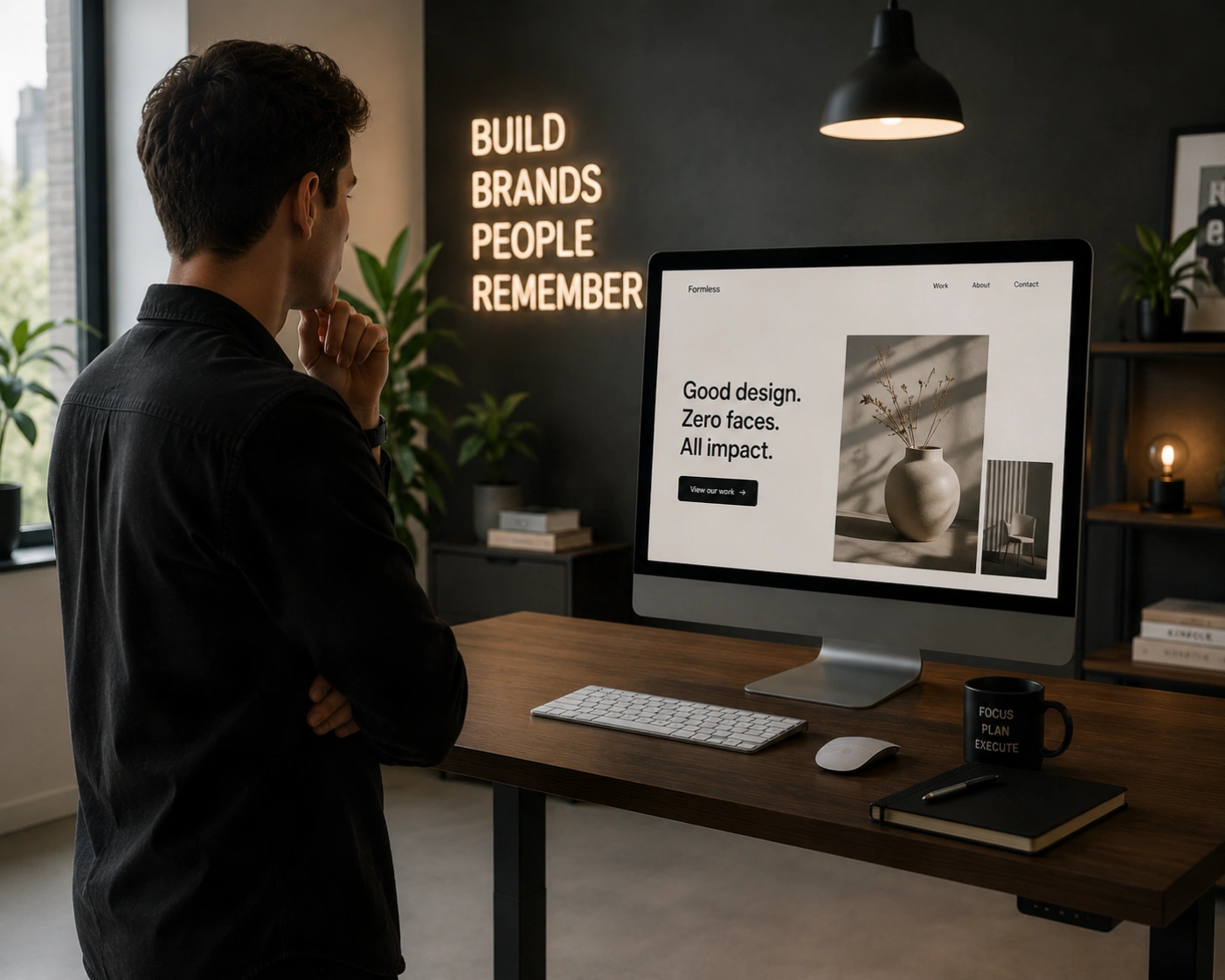
Something is shifting in how people choose the businesses they buy from. Across every industry and price point, consumers are increasingly indifferent to polished corporate presentation and increasingly drawn to brands that feel like they are run by real people with real opinions. The faceless business website — the one with stock photography of diverse handshakes, a mission statement written in committee, and a colour palette chosen to offend nobody — is losing ground to websites built around genuine personality, distinct voice, and the kind of specificity that only comes from a business that actually knows who it is and who it is for.
This is not a fringe trend. It is being driven by a fundamental shift in consumer trust. Years of exposure to interchangeable corporate content, combined with the flood of AI-generated material that makes generic output cheaper and more abundant than ever, have made authenticity genuinely scarce and therefore genuinely valuable. When everything looks the same and reads the same, the businesses that stand for something specific, and have the courage to say it clearly, stand out by default.
At AG Art Studio, we design websites that reflect who a business actually is, not who they think they should appear to be. Here is why personality-led design is winning, what it actually means in practice, and how to assess whether your website is doing it or not.
What a faceless brand actually looks like
A faceless brand is not necessarily a bad business. It is a business whose online presence communicates nothing distinctive about who runs it, what they believe, who they are trying to help, or why they do what they do differently from anyone else. The signs are consistent and recognisable: a homepage that opens with "We are a leading provider of X solutions," an About page that lists founding year and team size rather than story and perspective, service descriptions that read like they were assembled from industry templates, and photography that could belong to any business in any sector. The website functions as a placeholder rather than a presence.
The problem is not aesthetics. Many faceless websites look professionally designed. The problem is absence: the absence of a point of view, a voice, a reason to care. In a market where potential clients can find ten competitors in thirty seconds, a website that does not give them a reason to feel something about your business leaves them with no basis for choosing you over anyone else except price. And competing on price is a race to the bottom that nobody wins comfortably.
 Photo by Dylan Gillis on Unsplash
The six elements of a personality-led website
A voice that sounds like a person, not a press release
The most immediate signal of personality on a website is its writing. Copy that sounds like it was written by a committee of cautious professionals trying to appeal to everyone reads as generic regardless of how accurate it is. Copy that has a clear point of view, uses the language your specific clients use, and occasionally says something that a competitor would not say reads as human. This does not mean being casual or unprofessional. It means being specific. Specific about who you are for, specific about what you think, specific about what you find interesting or frustrating about your industry. Specificity is the mechanism through which voice creates connection, and connection is what turns a visitor who is browsing into a prospect who is genuinely interested.
Real photography of real people, places, and work
Stock photography is the visual equivalent of a generic voice. It signals that the business either does not have real assets worth showing or does not trust that its reality is compelling enough. Real photography of the founder, the team, the workspace, the process, and the actual work being done is the fastest way to make a website feel like a business that exists rather than a template that has been populated. Visitors form impressions of trustworthiness from visual cues before they read a word, and a face they can connect to a name builds credibility that no stock image of a smiling professional can replicate. Even imperfect real photography consistently outperforms polished stock imagery in conversion tests because it is honest, and honesty is what trust is built from.
 Photo by WOCinTech Chat on Unsplash
 Photo by Brooke Cagle on Unsplash
A point of view on your industry, not just a description of it
Personality-led brands have opinions. They have a perspective on how things should be done and they are willing to articulate it. This is one of the most underused differentiators available to small businesses, because large corporate brands rarely take strong positions for fear of alienating segments of their market. An independent business that says clearly what it believes about the right way to approach its craft, what it refuses to compromise on, and what it thinks the industry gets wrong has a genuine competitive advantage over every business in its space that presents itself as neutral and universally agreeable. An About page that says "we believe X" or a services page that explains what you will not do and why is far more distinctive than a page that attempts to be everything to everyone.
Clarity about who you are for and who you are not for
One of the most counterintuitive truths in business communication is that narrowing your stated audience increases rather than decreases conversion. When a website tries to speak to everyone, it resonates with no one because the visitor never experiences the recognition of being specifically addressed. When a website speaks directly to a specific type of person with a specific type of problem or aspiration, those people feel seen in a way that generic content never achieves. The businesses that are willing to say "we work best with clients who believe X" or "our work is not the right fit for everyone" create a selective quality signal that actually attracts more qualified clients than a broad, inclusive message does, because selectivity implies standards and standards imply quality.
A visual identity that reflects a genuine aesthetic, not a trend
Personality-led design does not mean following whatever visual trend is currently popular on design showcase sites. It means having a visual identity that is genuinely reflective of the business's aesthetic values and that remains consistent across every touchpoint. A brand with a strong visual identity makes decisions about typography, colour, spacing, and imagery from a coherent set of principles rather than assembling elements that look good individually without considering how they express something collectively. The visual identity should feel like it could only belong to this specific business, not like a theme that hundreds of other businesses in the same industry have also purchased. That specificity is what makes a design feel like a brand rather than a template.
 Photo by Hannah Busing on Unsplash
Content that teaches, challenges, or entertains rather than merely informs
Personality-led businesses create content that sounds like it was written by someone who actually cares about the subject rather than someone trying to cover a topic for SEO purposes. The distinction is immediately felt by readers: content with genuine perspective provokes thought, makes the reader feel something, and leaves them with a clear sense of who wrote it and what they believe. Generic informational content does none of these things. For businesses that publish blog posts, case studies, or social content, the shift from informational to perspectival is one of the highest-leverage changes available. It does not require more content. It requires more courage: the willingness to say what you actually think rather than what is safest to say.
The businesses winning online are not those with the most polished presentation. They are the ones brave enough to show who they actually are, who they are actually for, and what they actually believe.
Faceless brand vs personality-led brand: what the website says
| Page element | Faceless brand says | Personality-led brand says |
|---|---|---|
| Homepage headline | We deliver innovative solutions for your business needs | Specific, direct statement of who this is for and what changes |
| About page | Founded in 2015, we are a team of passionate professionals | The story of why, what is believed, and who belongs here |
| Service descriptions | Comprehensive end-to-end service tailored to your requirements | Specific outcomes, specific clients, specific approach and why |
| Photography | Stock images of laptops, handshakes, and diverse teams | Real faces, real spaces, real work in progress |
| Content / blog | Top 10 tips for X (indistinguishable from 1,000 other articles) | Genuine perspective with a point of view that could only come from this business |
| Social proof | Generic 5-star ratings with no specificity | Specific client stories that describe a real transformation |
Why this matters more now than it did five years ago
 Photo by Charles Deluvio on Unsplash

How to audit your website for personality
- Your homepage headline says something specific about who you are for and what changes for them, not a generic value statement about your business
- Your About page tells the story of why the business exists, what you believe, and who you are as a person, not just a chronology of credentials
- Your service descriptions name a specific type of client and describe specific outcomes rather than describing capabilities in abstract terms
- Real photography of you, your team, your workspace, or your process appears on the site without relying on stock imagery
- Your website has a visual identity that feels like it belongs to your specific business rather than being interchangeable with competitors in your industry
- Your copy contains at least one opinion or belief that a competitor would be unlikely to express, making your perspective clearly yours
- Your testimonials are specific enough that a reader can understand the client's situation before the project and the outcome after it
- Reading your site gives a clear impression of what working with you actually feels like, not just what you deliver
- The homepage passes the swap test: it could not belong to any of your direct competitors without significant changes
- Any content you publish has a clear point of view and says something that only your business would say, rather than covering topics generically
The shift toward personality-led brands is not a stylistic preference. It is a response to a market in which generic presentation has become valueless because it is now infinitely abundant and immediately recognisable as such. The businesses that invest in articulating who they genuinely are, for whom, and why, and then build their website around that clarity rather than around who they think they should appear to be, are building something that cannot be commoditised: a real identity in a sea of interchangeable options. That identity is the foundation of every other commercial advantage a business can build online, and it is the one thing no competitor can copy directly, because it is specifically and irreducibly yours.
It works particularly well for B2B businesses, because B2B purchasing decisions are ultimately made by people who have the same emotional responses to authenticity and connection that consumer buyers do. The myth that B2B buyers make purely rational decisions unclouded by feeling has been extensively challenged by research, and the evidence consistently shows that B2B buyers buy from businesses they trust and feel confident about, not just businesses with the best spec sheet. A B2B website with a genuine voice, a clear point of view, and real personality reduces the perceived risk of choosing a supplier in a way that polished but impersonal corporate presentation cannot match.
Start by collecting examples of how you talk about your work in real conversations, not how you write about it. The language you use when explaining what you do to a friend at dinner is almost always more interesting and more specific than the language you use on your website, because in conversation you are not trying to sound professional. Read those examples and identify the words, phrases, and attitudes that feel most naturally yours. Then apply that register to your web copy. A useful exercise is to write your About page as if you were telling your story to someone who has just asked how you ended up doing what you do. That version is almost always better than the formal credential-list version most businesses default to.
Yes, and that is precisely the point. Personality-led marketing filters out clients who are not a good fit before they enquire, which saves everyone time and improves the quality of the client relationships you do build. The businesses that are most anxious about alienating potential clients with a strong voice are often the ones that most need the clarity it provides, because they are spending significant energy on enquiries and projects that are never going to be satisfying matches. The fear of losing the wrong-fit client is much smaller than the cost of attracting and working with them. Strong personality does not reduce your total client pool to a manageable size. It refines it to a more valuable one.
The useful distinction is between personality and personal life. Personality on a business website means voice, values, perspective, and the human presence behind the business. It does not require sharing personal life details that are not relevant to the work or the client relationship. The test is whether the personal element you are considering sharing builds relevant trust or connection with the specific clients you want to work with. A designer sharing their aesthetic philosophy and what moves them creatively is professionally relevant and builds connection. The same designer sharing details of their personal relationships is not relevant and does not serve the visitor. Stay on the side of the line where everything you share illuminates something about how and why you do your work.
Yes, though the approach is different from a solo business or small studio. For a larger business, personality lives in the collective values and culture of the organisation rather than in a single founder's voice. The most effective approach is to identify the beliefs, principles, and ways of working that genuinely distinguish the business and build the website's voice around those rather than around an individual. Team pages that show real people with real perspectives, content that reflects genuine organisational knowledge and opinion, and visual identity that is specific rather than generic all contribute to personality at scale. The business most at risk of generic presentation is the mid-size company that has outgrown its founder's personality but not yet developed a distinct organisational one.
A personality problem typically manifests as low enquiry rates from visitors who otherwise match your ideal client profile, a high proportion of price-led enquiries where prospects seem to be shopping rather than seeking you specifically, or feedback from clients that they were not sure what made you different until after they started working with you. If your analytics show that visitors are arriving and spending time on the site but not enquiring, the content is engaging enough to hold attention but not specific enough to create conviction. If visitors are leaving immediately, the problem may be design, performance, or relevance rather than personality. The swap test is the quickest diagnostic: if your copy could belong to a competitor without modification, personality is the problem.